By Hektor Jorgo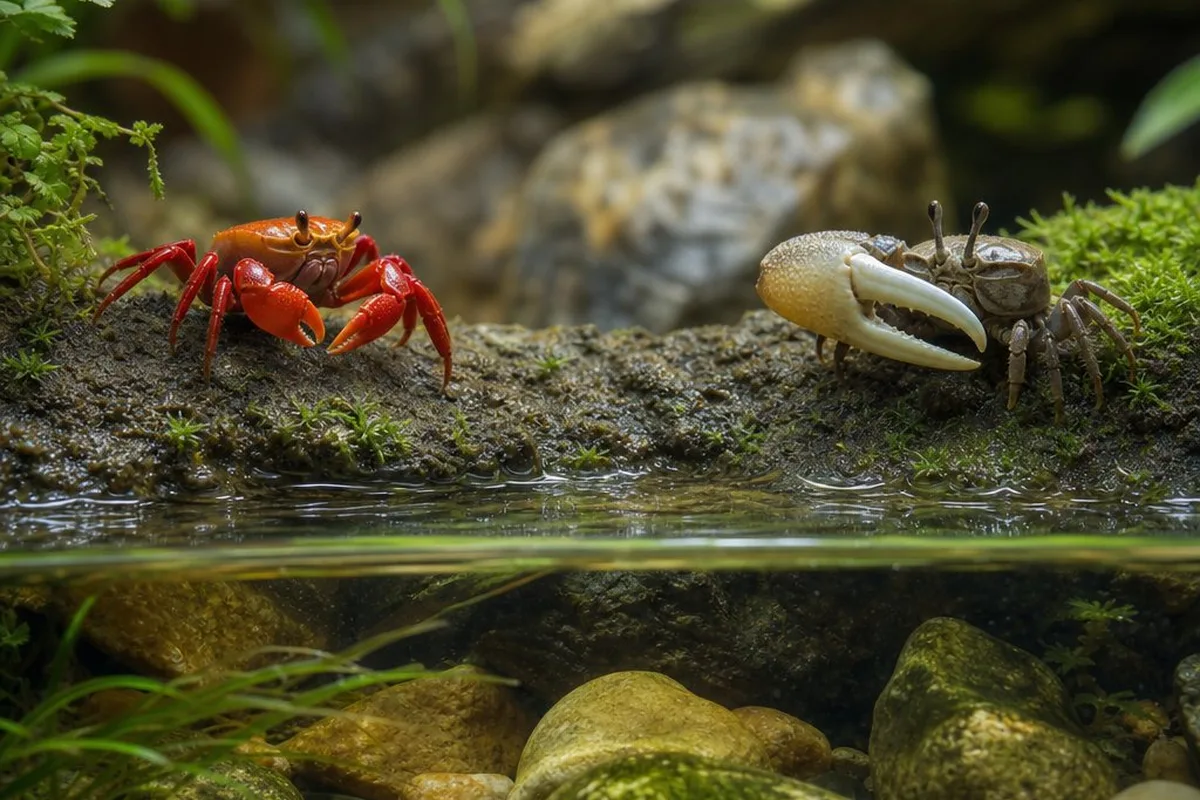
Red claw crabs and fiddler crabs look like a natural pairing on paper — similar habitats, similar setups, similar size. But "similar enough that they could theoretically share a habitat" and "compatible tank mates" aren't quite the same question once two crab species are involved.
Short Answer
Red claw crabs and fiddler crabs share enough habitat and setup overlap that the combination is sometimes attempted, but it's a higher-risk pairing than it might first appear, because combining two crab species introduces territoriality concerns that habitat overlap alone doesn't address. Both species are associated with brackish, semi-terrestrial habitats and need the kind of paludarium setup covered in our freshwater crabs for aquariums guide — that part lines up well. But both species can also be territorial, including toward their own kind, and two crab species are more likely to directly compete for the same land areas, hiding spots, and food than a crab and a fish or mudskipper would, as discussed in our fiddler-crab-and-mudskipper guide.
The Case For: Habitat and Setup Overlap
Red claw crabs and fiddler crabs do share real common ground:
- Both are associated with brackish, mudflat or mangrove-adjacent habitats
- Both are semi-terrestrial, needing access to land/emergent areas alongside water
- Both have omnivorous diets with a plant-matter lean, covered in our fiddler crab diet guide and red claw crab diet guide
If you were only looking at "do these two species' habitat and setup needs overlap," the answer would be a fairly confident yes — which is exactly why this combination gets considered in the first place.
The Case for Caution: Two Crabs, Not a Crab and a Fish
Here's where it gets more complicated. Crabs interact with their environment, and with each other, differently than fish do. Two crab species sharing a tank are more likely to want the same specific resources — the same basking rock, the same spot under a piece of driftwood, the same patch of land area — than a crab and a fish or mudskipper would, simply because their ecological roles and how they use space are more similar to begin with.
This is the core reason the red-claw-and-fiddler combination carries more risk than the fiddler-and-mudskipper combination, even though both pairings share a similar degree of habitat overlap on paper. Similarity in habitat needs can mean similarity in what gets fought over.
Both species can also display territorial behavior toward their own kind — which matters for two reasons: it means territoriality isn't unique to cross-species interactions, and it means a tank where same-species individuals are already having conflicts isn't a good candidate for adding a different species into the mix.
Making It Work: Space and Multiple Resource Points
If this combination is attempted, the most actionable lever is space — specifically, multiple distinct land areas, hiding spots, and basking sites, not just overall water volume. The goal is to reduce the odds that any two individuals (same species or different) need to directly contest the same limited resource at the same time. A tank that's technically "big enough" by water volume but has only one usable land area is a much higher-conflict setup than one with several distributed land/hiding options.
What to Watch For
The warning signs are similar to those for any mixed-crab or mixed-species paludarium: persistent chasing or claw aggression, one individual consistently excluded from land areas, visible injury, and hiding or appetite loss. Given the territoriality concern specific to this pairing, it's also worth confirming that same-species individuals are coexisting peacefully before adding a second species — conflict within a single species is a signal the tank isn't ready for more crabs of any kind yet.
Quick Reference
- Red claw crabs and fiddler crabs share brackish, semi-terrestrial habitat and setup needs
- Combining two crab species carries more territoriality risk than combining a crab with a fish/mudskipper
- Both species can be territorial, including toward their own kind
- Similar resource needs mean more potential for direct competition over the same spots
- Multiple distinct land areas/hiding spots reduce conflict risk more than total water volume alone
- Check that same-species individuals coexist peacefully before adding a second species
- Watch for chasing, exclusion from land areas, injury, or appetite loss after introduction