By Hektor Jorgo
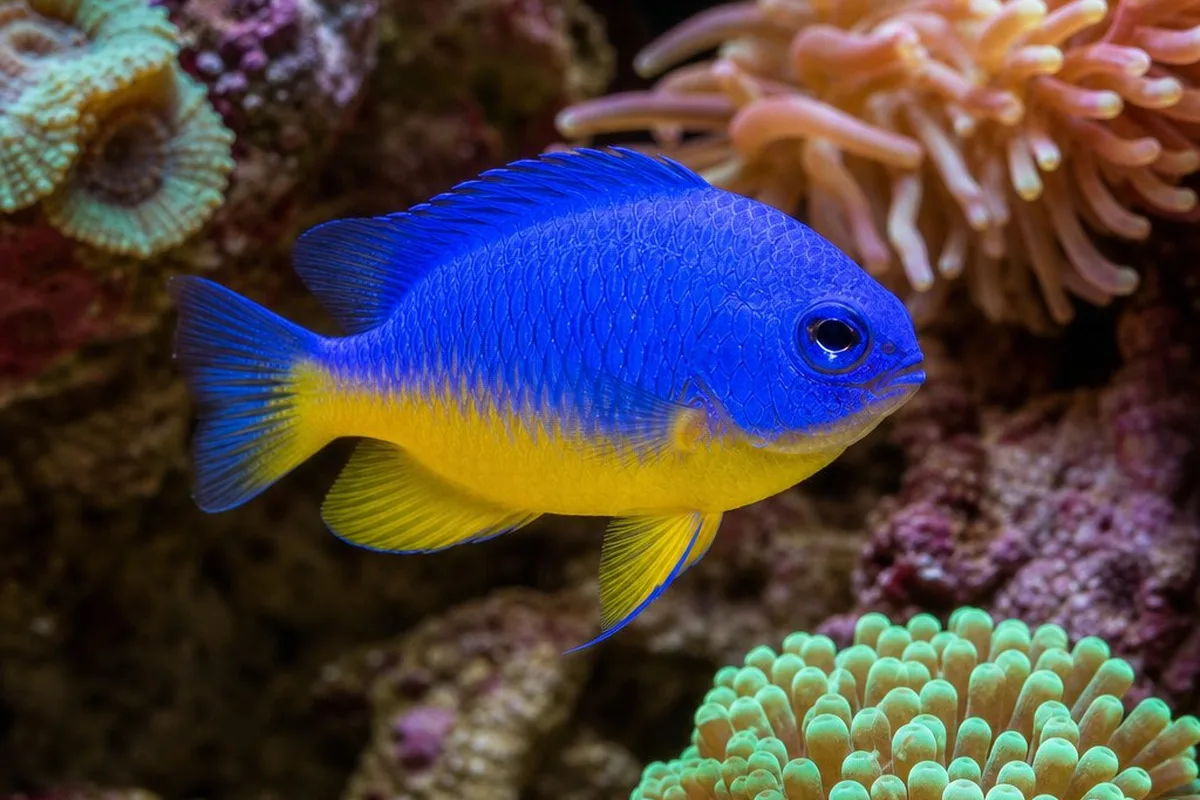
The azure damselfish (Chrysiptera hemicyanea) is often seen in the wild forming loose groups over open rubble flats near reef cover — a sight that understandably makes "should I get a few?" a common question. The honest answer is that this wild grouping behavior doesn't map cleanly onto a home aquarium, where space is finite and territories can't simply spread out the way they would on a reef. This guide covers how many azure damselfish you can realistically keep together, and the specific setup choices that determine whether a group works or turns into a chase-fest.
Short Answer: How Many to Get
For most home aquariums, one azure damselfish is the simplest and lowest-conflict choice — this species does perfectly well kept singly and doesn't show the stress signs of a true shoaling fish kept alone. If you specifically want multiple azure damselfish, plan for 50+ gallons with rockwork divided into several distinct territories, and add all individuals at the same time, ideally during initial stocking rather than introducing new ones to an established tank. Adding a second azure damselfish weeks or months after the first is the most common way this goes wrong.
Azure Damselfish Social Structure: Wild vs. Aquarium
In the wild, C. hemicyanea forms loose aggregations over open sand or rubble patches near reef structure — multiple individuals visible in the same general area, each ranging over a feeding territory that can expand or contract based on how much space and competition is around. Critically, a wild reef offers something a tank can't: effectively unlimited space to retreat to if a territorial dispute doesn't go your way.
In an aquarium, that escape valve doesn't exist. A subordinate azure damselfish that would simply move to another patch of reef in the wild instead has nowhere to go — and "nowhere to go" combined with ongoing aggression from a tankmate is the recipe for the stress, hiding, and fin damage that group-stocking problems usually look like.
How Many Can You Keep Together?
There's no single number that applies to every tank, but a few general patterns hold:
- One azure damselfish — works in almost any appropriately sized tank (20+ gallons per our main care guide). No group dynamics to manage.
- Two or more azure damselfish in under 50 gallons — high risk of one individual (usually whichever establishes territory first, or the larger individual) persistently dominating the other(s). Not recommended as a default plan.
- Multiple azure damselfish in 50+ gallons with abundant, divided rockwork — more workable, particularly if all individuals are added simultaneously so no single fish gets a head start on claiming the whole tank as its territory.
- Larger tanks (75-100+ gallons) with extensive rockwork structured into multiple separate "zones" — closer to replicating the wild scenario where multiple individuals can each have a territory without constant direct conflict.
The underlying variable in all of these isn't really "gallons" in the abstract — it's how many separate, defensible territories the rockwork creates, and whether each azure damselfish can claim one without overlapping heavily with another's.
Adding Multiple Azure Damselfish Without Conflict
If you're set on keeping more than one, the single most important technique is simultaneous introduction:
- Add all individuals at the same time, ideally as part of your tank's initial stocking. This means no single fish has weeks or months to establish itself as "the resident" before others arrive — a major factor in how one-sided territorial aggression develops.
- Provide more rockwork than you think you need, structured to create multiple separate cave/crevice clusters rather than one large connected rock structure. Each cluster can become a separate fish's territory.
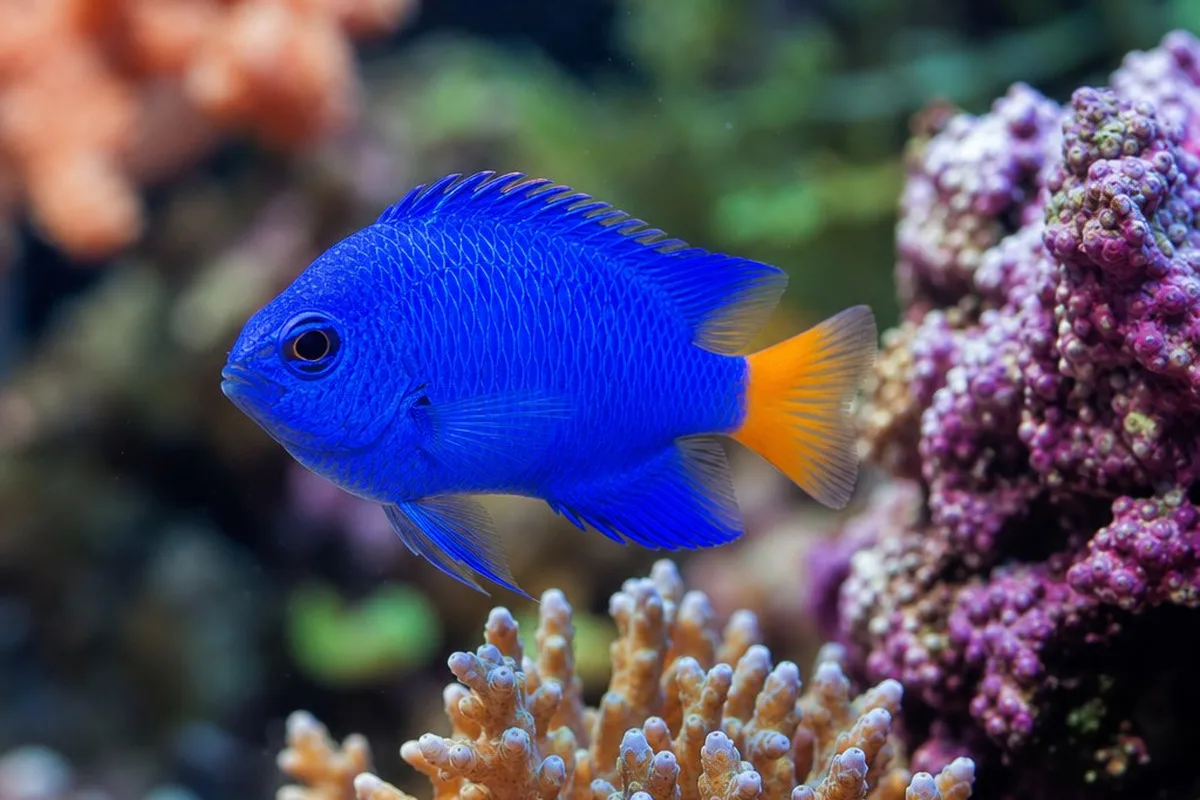
- Avoid adding other blue Chrysiptera species (like the blue devil damselfish) to the same tank as a group of azure damselfish — this multiplies the number of fish reading each other as rivals, on top of the within-species dynamics already at play.
- Watch the first few weeks closely. Some settling-in squabbling as territories get established is normal; persistent one-sided chasing that doesn't reduce over 2-3 weeks is a sign the setup isn't supporting the group the way it needs to.
What Happens If You Get the Numbers Wrong
The most common outcome of an unsuccessful azure damselfish group isn't dramatic — it's a slow, persistent pattern where one or two fish dominate and one or more others spend most of their time hiding, show fin damage from chasing, and gradually feed less. This tends to not resolve on its own and often gets worse over time as the dominant fish's territory effectively expands to cover the whole tank.
If you're seeing this pattern, the realistic options are: significantly increase rockwork/territory division, increase tank size, or separate/rehome the conflicting individuals. "Wait and see if they work it out" is rarely the outcome with damselfish once a clear dominance pattern has set in — this is a behavior pattern, not a temporary adjustment period.
Quick Reference
- Default recommendation: one azure damselfish per tank — no group dynamics to manage
- If keeping multiple: 50+ gallons minimum, with rockwork divided into separate territories
- Add all individuals simultaneously, ideally during initial stocking
- Avoid combining with other blue Chrysiptera species (e.g., blue devil damselfish)
- Some settling-in squabbling is normal; persistent one-sided chasing past 2-3 weeks is not
- If considering a larger tank for a group, see our 30-gallon and beyond stocking guides for how this fits into a broader plan
- One azure damselfish does not show "loneliness" stress — it's a fine standalone choice