By Hektor Jorgo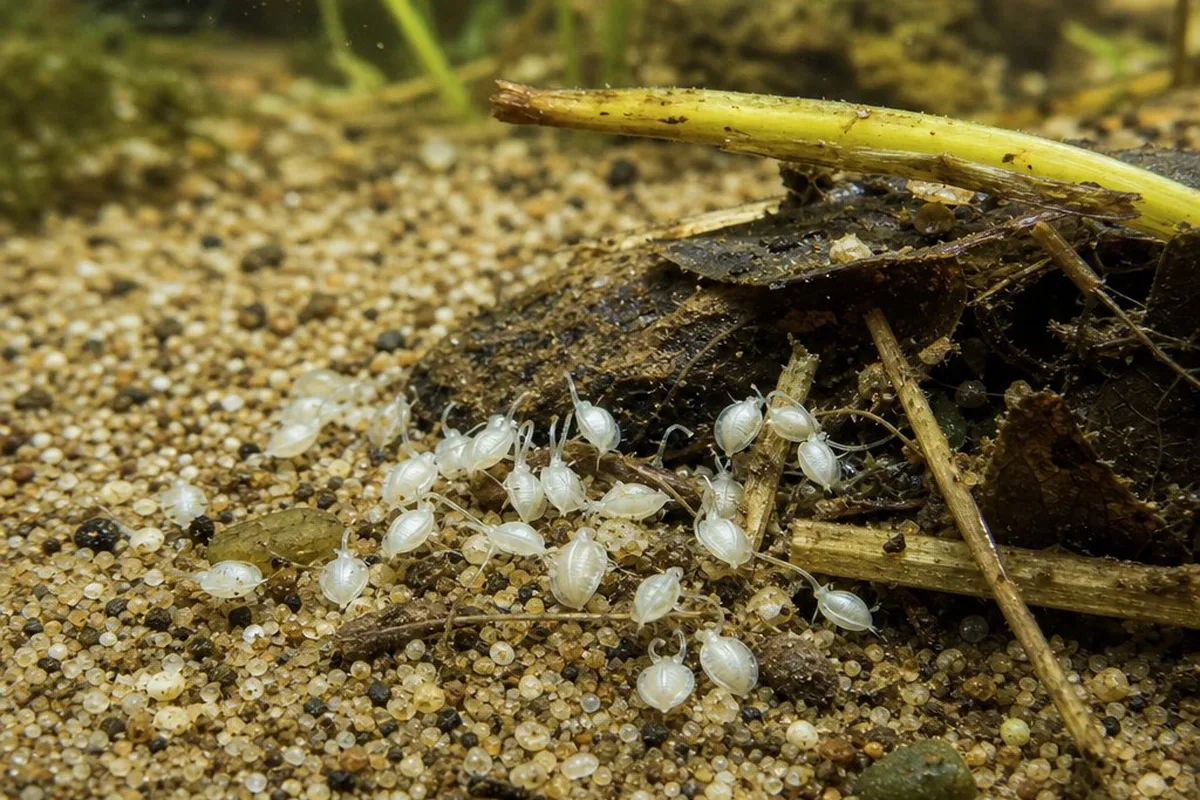
You're doing a water change or just leaning in close to the glass, and you notice them — tiny white specks moving around the substrate, the decorations, or the inside of the tank walls. Before assuming the worst, it helps to know that this is one of the most common things turtle keepers notice, and in almost every case, it's a sign about your tank's maintenance routine rather than a threat to your turtle.
Short Answer
Small white bugs or worms in a turtle tank are almost always detritus worms, planaria, or seed shrimp (ostracods) — all harmless scavengers that feed on excess organic waste rather than on your turtle. None of them are parasites, and none pose a direct health risk. Their presence is mostly useful as a signal: a growing population usually means there's more leftover food and waste building up than your current feeding and cleaning routine is accounting for. The fix is almost always about adjusting feeding and cleaning, not about treating the tank for "bugs."
The Most Likely Candidates
A few organisms account for the vast majority of "little white bugs" reports in turtle tanks:
- Detritus worms — thin, pale, segmented worms, usually under half an inch, that wriggle slowly through substrate, along the glass, or around decorations. They're decomposers, feeding on decaying plant matter, leftover food, and waste. A small number is essentially universal in any established tank; a visible, growing population usually tracks with extra organic matter.
- Planaria — flatworms that are typically tan, white, or slightly translucent, with a smooth, gliding movement rather than the wriggling motion of detritus worms. Planaria populations often spike specifically in response to overfeeding, since they reproduce quickly when food is abundant.
- Seed shrimp (ostracods) — tiny, oval, white-to-cream crustaceans that move in quick darting bursts. Despite the name, they're not closely related to the shrimp kept as tank inhabitants — they're more of an opportunistic scavenger that shows up on its own in tanks with organic buildup.
- Springtails — less commonly mentioned, but if you're seeing small white organisms that seem to jump or hop near the water's surface or on damp surfaces above the waterline (like a basking platform), springtails are a possibility. They're terrestrial-leaning decomposers more associated with the damp areas around a tank than the water itself.
None of these require a turtle-specific treatment, and none are linked to disease transmission in turtles.
Why They're Showing Up
The honest answer is usually: there's more organic matter available to feed on than there was before. Turtle tanks are particularly prone to this for a couple of reasons. Turtles are messy eaters — food gets torn apart, and pieces drift into substrate and corners where they're easy to miss during routine cleaning. Turtles also produce a substantial amount of waste relative to their size, more so than most fish of comparable size, which adds to the organic load a filter and cleaning routine need to keep up with.
None of this means the tank is "dirty" in an unsafe sense — these organisms are a normal part of the ecosystem in any tank with organic matter present, including healthy, well-run ones. But a sudden increase in their numbers, especially a visible population explosion, is a reasonably reliable early signal that feeding amounts or cleaning frequency could use a second look before it becomes a bigger water-quality issue.
Is This a Mosquito Larvae Situation Instead?
It's worth pausing to rule this out, because mosquito larvae are a genuinely different situation with a different cause and fix. The organisms covered above are generally small (a few millimeters at most), move slowly or in short bursts, and are found throughout the water column, substrate, and glass. Mosquito larvae are noticeably larger, hang near the surface, and move with a distinctive wriggling, looping "comma shape" motion when disturbed. If that description matches what you're seeing more than "tiny specks crawling on the glass," our guide to mosquito larvae in turtle tanks covers what's actually going on and what to do about it — the cause (mosquitoes laying eggs on the water's surface) has nothing to do with overfeeding.
What to Actually Do About It
If you've confirmed it's one of the detritus-feeding organisms above, here's the practical sequence:
- Reassess feeding. If food is sitting in the tank for more than a few minutes before being eaten (or not eaten at all), that's the most common driver. Reduce the amount slightly and remove uneaten portions promptly.
- Do a more thorough substrate clean during your next water change — detritus worms and seed shrimp populations are often concentrated in substrate pockets that don't get disturbed during routine maintenance.
- Check filtration capacity. Turtle tanks need filtration sized for the turtle's bioload, not just the tank's water volume — an undersized filter struggles to keep up with the organic load these organisms feed on. If you're also working out the right overall tank size for your turtle, our guides on musk turtles in a 20-gallon tank and whether a 30-gallon tank works for a turtle cover how tank size and filtration needs scale together.
- Don't aim for zero. A small, stable background population of these organisms is normal and not worth chasing to complete elimination — the goal is keeping organic load in check, which naturally keeps numbers low without becoming a constant battle.
Quick Reference
- Small white bugs/worms in a turtle tank are usually detritus worms, planaria, or seed shrimp (ostracods)
- None of these are parasites or a direct health risk to the turtle
- A population increase usually signals extra organic waste — most often from overfeeding
- Mosquito larvae are a different, larger organism with a distinctive looping motion near the surface
- Reduce feeding slightly and remove uneaten food promptly as the first step
- A thorough substrate clean and adequate filtration address the underlying cause
- A small background population is normal — don't expect or aim for complete elimination