By Hektor Jorgo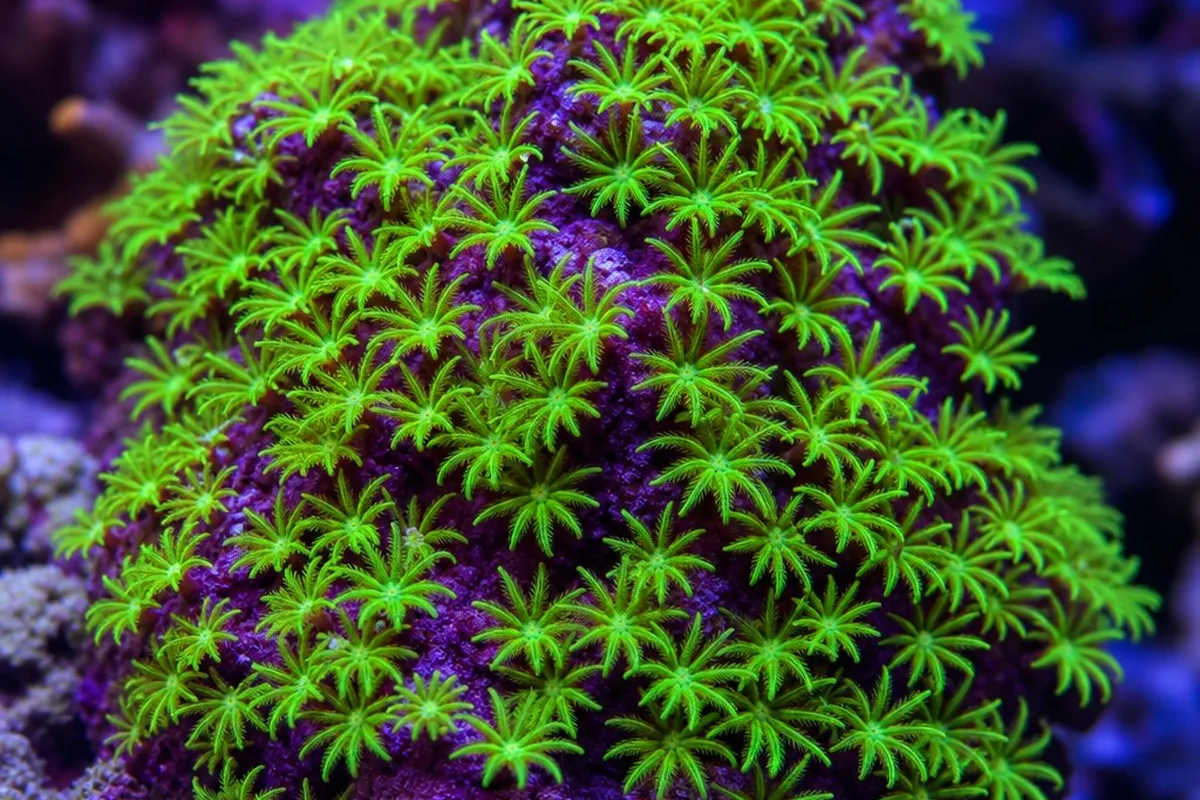
Ask a roomful of reef keepers about green star polyps and you'll get two reactions, often from the same person at different points in their hobby journey: "this is one of the easiest corals I own" and "I really wish I hadn't put it where I put it." Both are true, and both come down to the same trait — GSP grows fast, and it grows by spreading across surfaces, not just upward.
How Fast Is "Fast"?
Green star polyps (Pachyclavularia or Briareum, depending on classification) grow by encrusting — extending a living mat directly across whatever it's attached to, with bright green star-shaped polyps covering a purple-to-mauve base. Under good conditions, a small starter frag can visibly expand its footprint within weeks, and noticeably encrust new rock, glass, or equipment within a few months. This puts GSP near the top of the list for growth rate among commonly kept corals — well ahead of most LPS species like the hammer and torch corals covered elsewhere on this site, which grow at a much more measured pace.
What Drives the Growth Rate
A few factors combine to make GSP's growth rate what it is:
- Encrusting growth form — spreading across a surface covers area faster than growing a discrete structure upward
- Broad tolerance — GSP handles a wide range of lighting intensities, flow rates, and nutrient levels, meaning it keeps growing under conditions that would slow other corals
- Resilience to minor disturbance — trimming, fragging, or accidental contact rarely sets GSP back for long, unlike more delicate corals that can take weeks to recover from similar disturbance
Together, these mean GSP doesn't just grow reliably — it grows persistently, across a wider range of tank conditions than almost anything else you might keep.
The Other Side of Fast Growth
Fast, reliable growth sounds like an unqualified positive, and for a beginner looking for visible progress, it often is. But the same traits that make GSP easy also make it something reef keepers commonly need to actively manage:
- Overgrowing neighbors — GSP can physically spread onto and over slower-growing corals placed nearby, to those corals' detriment
- Encrusting rockwork — a colony that's spread across your aquascape can make future rearranging difficult, since moving the rock means cutting through living coral
- Colonizing equipment — powerhead housings, overflow boxes, and similar hardware in the coral's reach aren't off-limits to GSP
None of this means GSP is a "bad" coral — it means GSP's growth rate is a design constraint worth planning around, the same way a gardener plans around a fast-spreading ground cover plant: useful and attractive within a defined area, a maintenance task outside of it.
Containing GSP From the Start
The most effective approach is simple and proactive: give a new GSP frag its own dedicated rock or frag plug, with some open sand bed or bare glass between it and your main rockwork and other corals. This lets the colony spread freely within a defined "island" without immediately threatening neighbors. For colonies that are already established and spreading further than wanted, periodic trimming or scraping back the growing edge is the standard response — GSP tolerates this well and simply regrows within whatever boundary you maintain.
Fast Growth Isn't the Same as "Easy Forever"
It's worth contrasting GSP with another fast-growing soft coral, xenia, which can also spread quickly under good conditions but has a separate, somewhat notorious reputation for sometimes declining or "melting" for reasons that aren't always fully understood. The lesson from putting these two corals side by side: growth rate and long-term reliability are related but separate questions. GSP happens to score well on both — fast-growing and generally reliable — which is a big part of why it's recommended so often as a first coral, provided its placement is planned with that growth rate in mind from day one.
Quick Reference
- GSP spreads by encrusting across surfaces — among the fastest growth rates of any commonly kept coral
- Broad tolerance for lighting, flow, and nutrients means it keeps growing under conditions that slow other corals
- Unchecked growth can overgrow neighboring corals, encrust rockwork, and colonize equipment
- Place new frags on their own rock/plug with separation from other corals as the main containment strategy
- Established colonies can be trimmed back periodically — GSP tolerates this well
- Fast growth and long-term reliability are separate traits — GSP scores well on both, unlike some other fast-growing soft corals