By Hektor Jorgo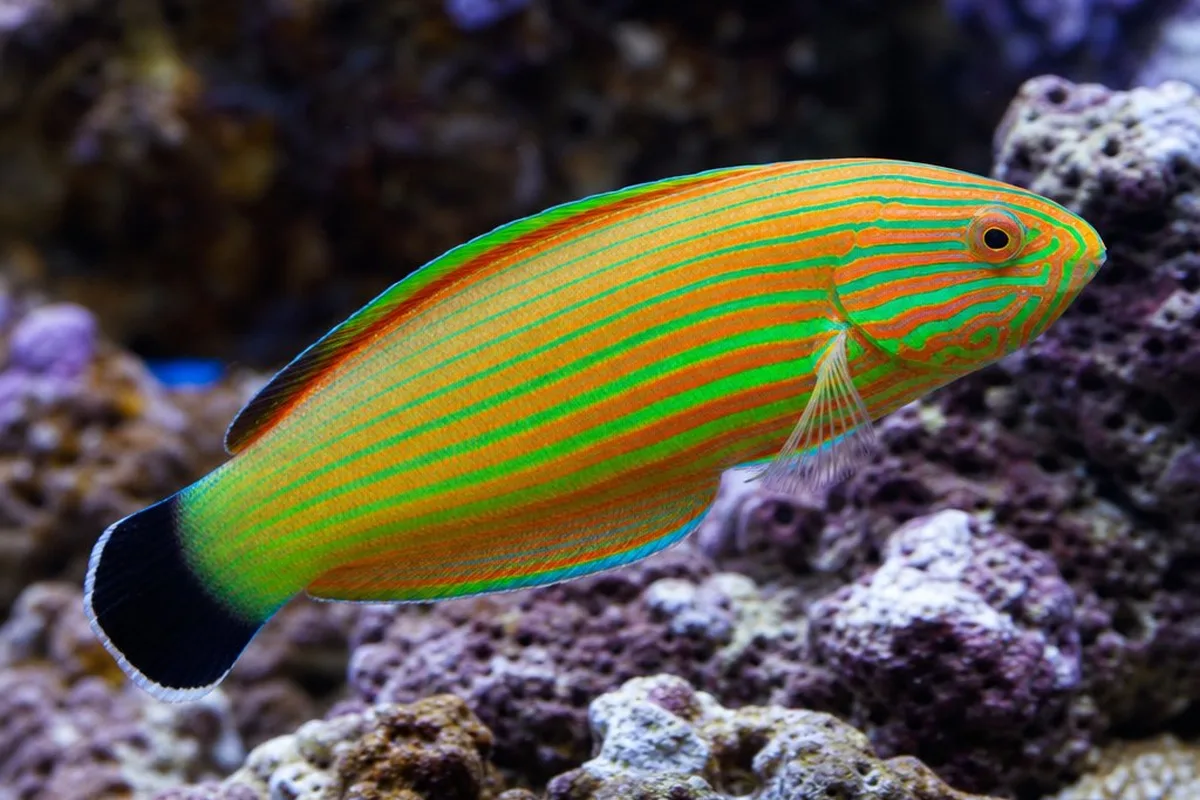
If you've searched for "female melanurus wrasse" expecting a simple side-by-side comparison photo, the honest answer is a little more interesting than that: this species' males and females can look different enough to be mistaken for two different fish entirely, and — unlike most pets — the "female" label isn't necessarily permanent. The melanurus wrasse (Halichoeres melanurus) is a small, active, reef-safe wrasse popular for its pest-snail-eating habits, and understanding its sexual dimorphism (and sequential hermaphroditism) helps explain both what you're looking at in a tank and why two melanurus wrasses bought as "females" might not both stay that way.
Short Answer: What Distinguishes a Female Melanurus Wrasse
Female melanurus wrasses tend to show more muted coloration — greens and browns with relatively simple horizontal striping — compared to the brighter, more elaborately marked terminal-phase males, which develop a vivid green or blue body with bold orange/yellow accents and a characteristic dark spot near the tail base. However, juveniles of both sexes often look similar, and because this species can change sex over its lifetime (from female to male), a fish's coloration — and its sex — isn't necessarily a fixed, lifelong trait the way it would be in most animals.
What the Melanurus Wrasse Is
Halichoeres melanurus, sometimes called the melanurus wrasse, Hoeven's wrasse, or tail-spot wrasse, is a small (typically 3-4 inch), active, reef-safe wrasse from the Indo-Pacific. It's a popular aquarium fish for a few practical reasons: it's hardy, reef safe, visually striking once it reaches more colorful phases, and it actively hunts and eats small pest invertebrates — including pyramid snails, which can otherwise target clams in a reef tank.
Like most members of the wrasse family (Labridae), H. melanurus is a protogynous hermaphrodite — broadly, individuals can start as females (or in a less-differentiated "initial phase") and some later transition to males, typically developing the brighter "terminal phase" coloration associated with that change. This isn't unique to melanurus wrasses; it's a well-studied pattern across many reef wrasse species and several other reef fish families.
How to Tell Females From Males
In practice, identification comes down to coloration and pattern complexity, with the caveat that this is a spectrum rather than two fixed categories:
- Females / initial phase — generally show simpler patterns: muted green or olive-brown base coloring with relatively plain horizontal striping, less bold contrast between colors, and a less prominent or absent tail spot.
- Terminal phase males — develop noticeably brighter coloration: a more vivid green or blue body, bold orange or yellow markings (often forming more complex patterns around the head and body), and the characteristic dark "tail spot" that gives the species its common name.
- Juveniles — often resemble the female/initial phase coloration regardless of what sex they'll eventually express, which is why young melanurus wrasses sold in stores can be difficult to confidently sex.
If you're trying to identify a specific fish, the most reliable approach is usually to compare it against multiple reference photos of confirmed females and confirmed terminal-phase males side by side, rather than relying on a single feature — pattern complexity and overall color vibrancy, taken together, are more informative than any single marking.
Can a Female Become a Male?
Yes — this is the part of melanurus wrasse biology that surprises a lot of new keepers. Sequential hermaphroditism (specifically, protogyny — female-to-male transition) is documented across many wrasse species. In the wild, this is often linked to social structure: in a group with one dominant terminal-phase male, if that male is removed (or dies), one of the remaining females may transition to take its place, including developing the associated coloration change over time.
In a home aquarium, this means:
- A fish purchased and confidently identified as a "female" based on coloration isn't guaranteed to remain in that phase indefinitely
- If you're specifically trying to avoid having two males (which can lead to territorial conflict in this and many other wrasse species), buying multiple "females" doesn't permanently guarantee that outcome
- This is a normal, healthy part of the species' biology — not a sign of illness or a tank problem if you observe a fish's coloration gradually shifting toward a more "male" appearance over months
Care Considerations
Beyond identification, melanurus wrasses share a few care requirements regardless of sex or phase:
- Sand bed required — like most Halichoeres wrasses, melanurus wrasses dive into fine sand to sleep at night and when startled. A sand bed of at least 2-3 inches of fine sand is a setup requirement, not a preference; crushed coral or coarse substrate doesn't serve the same function and can be abrasive.
- Secure lid — active wrasses are capable jumpers, particularly when startled.
- Reef safe and beneficial — melanurus wrasses are a popular addition specifically for pest control, including pyramid snails that target clam mantles, fitting well into the kind of coral-and-invertebrate reef setups discussed in our reef-safe stocking guide.
- Minimum tank size around 30 gallons — comparable to the lower end of what's recommended for common clownfish and other small reef fish, though as with the considerations in our 10-gallon stocking guide, an active swimming fish like this benefits from more open space than the bare minimum.
- Multiple individuals — if keeping more than one melanurus wrasse, a larger tank with plenty of rock and sand reduces territorial conflict, particularly if one individual transitions toward terminal-phase coloration and behavior over time.
Quick Reference
- Females/initial phase: muted green/olive coloring, simple striping, little or no tail spot
- Terminal phase males: brighter green/blue body, bold orange/yellow markings, dark tail spot
- Juveniles of both sexes often resemble the female/initial phase coloration
- This species can change sex (female to male) — coloration isn't necessarily permanent
- Provide 2-3+ inches of fine sand for sleeping and refuge behavior
- Minimum tank size around 30 gallons, secure lid required
- Reef safe and useful for pest snail control, including pyramid snails
- If keeping multiple individuals, provide ample space to reduce territorial conflict as phases shift