By Hektor Jorgo
The domino damselfish, also sold as the threespot dascyllus (Dascyllus trimaculatus), is one of those fish that gets bought on impulse far more often than it should be — and that's not a knock on the fish, it's a warning about its growth curve. As a juvenile, it's a jet-black, polka-dotted ball of personality that will practically eat from your fingers within days. As an adult, it's a sturdy, deep-bodied, territorial fish more than twice that size, with a temperament to match. This guide walks through what a domino damselfish actually needs at full size, so you can decide if it fits your long-term plans rather than just your current tank.
Appearance and Natural Range
Juvenile domino damselfish are unmistakable: a deep black (sometimes near-purple-black) body with three crisp white spots — one on the forehead and one on each side, just behind the gill cover. As the fish matures, these spots often fade, sometimes to the point of nearly disappearing in older adults, and the body deepens into a more rounded, robust shape. Adults reach roughly 5.5 inches (14 cm), dwarfing the 2-inch juveniles typically sold in stores.
D. trimaculatus is found across a huge swath of the Indo-Pacific and Red Sea, on reef flats and slopes from very shallow water down to around 50 meters. Juveniles are frequently found sheltering among the tentacles of large sea anemones (a behavior they share with clownfish, despite not being clownfish), while adults form loose aggregations over rubble and coral heads, retreating into crevices when threatened. In the aquarium, this translates to a fish that wants — and as an adult, will aggressively defend — a substantial piece of rockwork as its own.
Tank Requirements
Tank Size
This is the most important section for anyone considering a domino damselfish. A juvenile can technically survive in a 20-gallon tank for a while, but that's not where this fish belongs long-term. Plan for 55 gallons (210 liters) minimum for a single adult, and more if you intend to keep it with other fish — which you should, since a domino in a tank that small with no other occupants tends to become even more territorially wound-up. Think of the small juvenile size as a temporary state, not the baseline for sizing your reef tank.
Aquascaping
Domino damselfish want substantial rockwork — not just crevices, but real structure they can patrol around and retreat into. Because adults are strong, somewhat blunt swimmers that will barrel through gaps and shove past obstacles while chasing other fish or defending territory, secure all rockwork and frags with reef-safe epoxy or rock-locking pins. An unsecured rock pile is a real risk with a full-grown domino in the tank — not because it's trying to wreck your aquascape, but because it doesn't notice or care that it's in the way.
Water Parameters
| Parameter | Target Range |
|---|---|
| Temperature | 74-78°F (23-26°C) |
| Salinity | 1.021-1.025 SG |
| pH | 8.1-8.4 |
| Ammonia / Nitrite | 0 ppm |
| Nitrate | <20 ppm |
| Alkalinity | 8-12 dKH |
Domino damselfish are among the toughest fish you can put in a marine tank, full stop. They tolerate temperature swings, salinity fluctuations, and the ammonia/nitrite spikes of an immature biological filter better than almost anything else commonly sold — which is exactly why they (like other damsels) have a long history as "cycling fish." That hardiness is real, but it's not an excuse to run poor water quality long-term; it just means a domino will likely be the last fish in your tank to show the consequences.
Diet and Feeding
Domino damselfish are aggressive, opportunistic feeders that will eat almost anything that fits in their mouth:
- Marine pellets (2-3mm for adults, smaller for juveniles)
- High-quality marine flake
- Frozen mysis shrimp, brine shrimp, and chopped seafood (silversides, krill)
- Nori/dried seaweed for grazing — adults appreciate occasional algae-based foods
Feed once or twice daily, in amounts consumed within a couple of minutes. Adults have a noticeably bigger appetite than the typical small damsel, and they'll dominate the feeding response in a community tank — make sure slower or more timid tank mates are still getting food, especially if a domino is present.
Tank Mates and Compatibility
This is the crux of keeping Dascyllus trimaculatus successfully: its compatibility profile changes dramatically as it grows, and what worked at 1.5 inches will not work at 4-5 inches.
As a juvenile, a domino damselfish is genuinely one of the friendliest-acting fish in the trade — bold, curious, and largely tolerant of similarly sized tank mates. This is the trap: people stock based on juvenile behavior and end up with a problem fish a year later.
As an adult, expect:
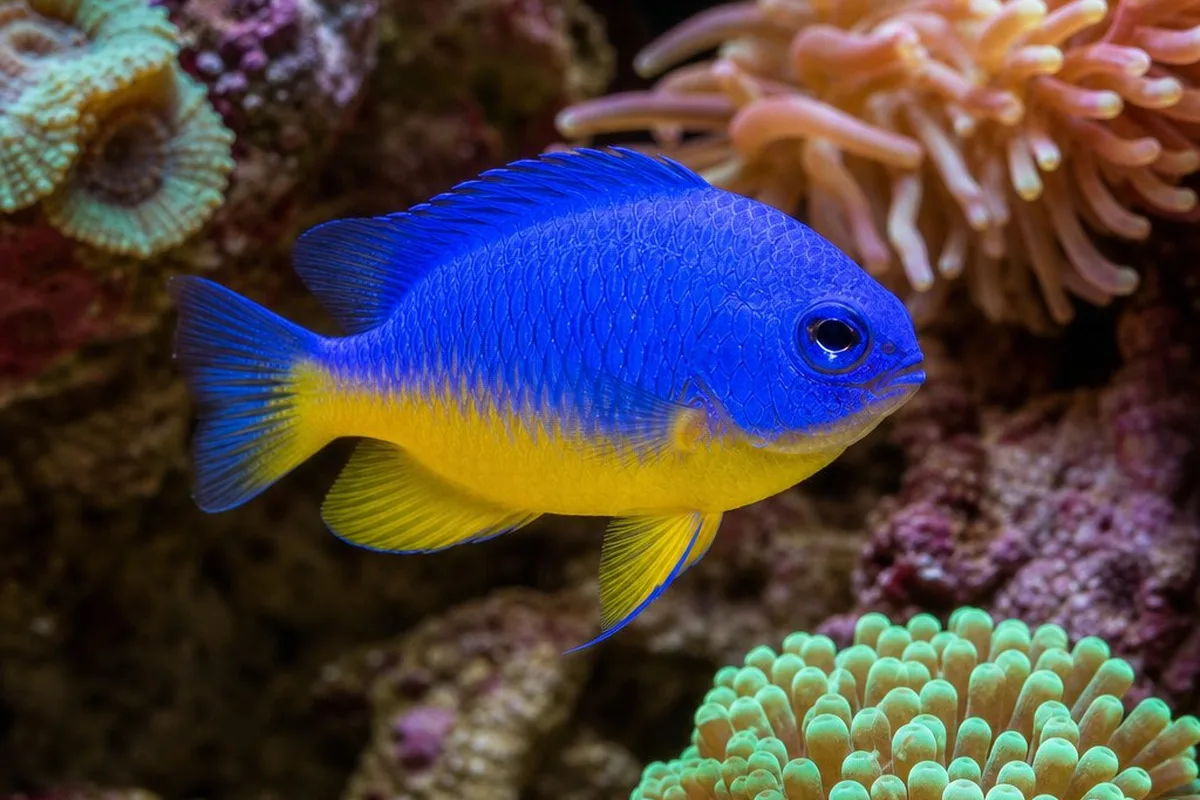
- Strong aggression toward smaller or similarly sized fish, especially other damsels. A domino will typically out-compete and bully smaller Chrysiptera species like the azure damselfish or blue devil damselfish unless the tank is large enough for both to hold separate territories.
- Better results pairing with fish that are either much larger (tangs, larger wrasses, angelfish in appropriately sized systems) or fast and agile enough to avoid confrontation (certain wrasses, larger gobies).
- The yellowtail damselfish and other small Chrysiptera can coexist with a domino only in larger tanks with abundant rockwork dividing territories — in anything under about 75 gallons, expect the domino to dominate.
If you want multiple dominoes, buy similarly sized juveniles and introduce them together — this is far easier than introducing a new domino to an already-established, territorial adult, which usually goes poorly for the newcomer.
Breeding in the Home Aquarium
Domino damselfish are egg-layers, and Dascyllus species are known to form spawning pairs and lay demersal eggs on cleaned rock surfaces, with the male guarding the clutch — similar in broad strokes to other damselfish breeding behavior. That said, spontaneous breeding in a mixed home reef tank is uncommon for this species compared to smaller, more prolific damsels like the yellowtail damselfish. Most domino damselfish in home aquariums are kept singly or in small same-sex-skewed groups specifically because of their aggression, which doesn't create the conditions for natural pairing.
If a true bonded pair does form (more likely in a large, lightly stocked tank with two similarly sized individuals raised together from juveniles), expect the same general pattern as other damsels: a cleaned rock surface, a clutch of eggs guarded and fanned by the male, and a hatch roughly 4-6 days later into pelagic larvae that will be lost to filtration in a typical display tank without a dedicated larval-rearing setup. For most aquarists, though, this is a fish kept for its hardiness and presence rather than its breeding potential.
Common Health Issues
Domino damselfish are about as disease-resistant as marine fish get, but watch for:
- Marine ich (Cryptocaryon irritans) — dominoes can carry it asymptomatically while more sensitive tank mates show visible spots.
- Injuries from aggression — both inflicted by the domino on others, and occasionally sustained by the domino itself if housed with fish large enough to retaliate.
- Obesity/poor coloration from overfeeding — adults' large appetites can lead to overfeeding if you're not careful, contributing to nitrate problems and a less vibrant-looking fish.
A 2-4 week quarantine for new arrivals is still good practice, even though a domino is unlikely to be the fish that gets sick. One practical note specific to this species: because juveniles are often sold quite small and grow quickly on a generous diet, it's worth weighing whether your quarantine tank can comfortably hold the fish at the size it will reach in 6-12 months, not just the size it is at the pet store. A domino that outgrows its quarantine setup before you're ready to move it to the display is a common source of avoidable stress.
Quick Setup Checklist
- Tank: 55+ gallons for an adult, fully cycled before adding fish
- Substantial rockwork, securely fixed with epoxy or rock pins
- Salinity 1.021-1.025, temperature 74-78°F
- Marine pellet/flake diet plus frozen mysis, brine, and occasional seaweed
- Stocking plan that accounts for adult size and aggression, not just juvenile behavior
- If keeping multiple dominoes: introduce similarly sized juveniles together, not sequentially