By Hektor Jorgo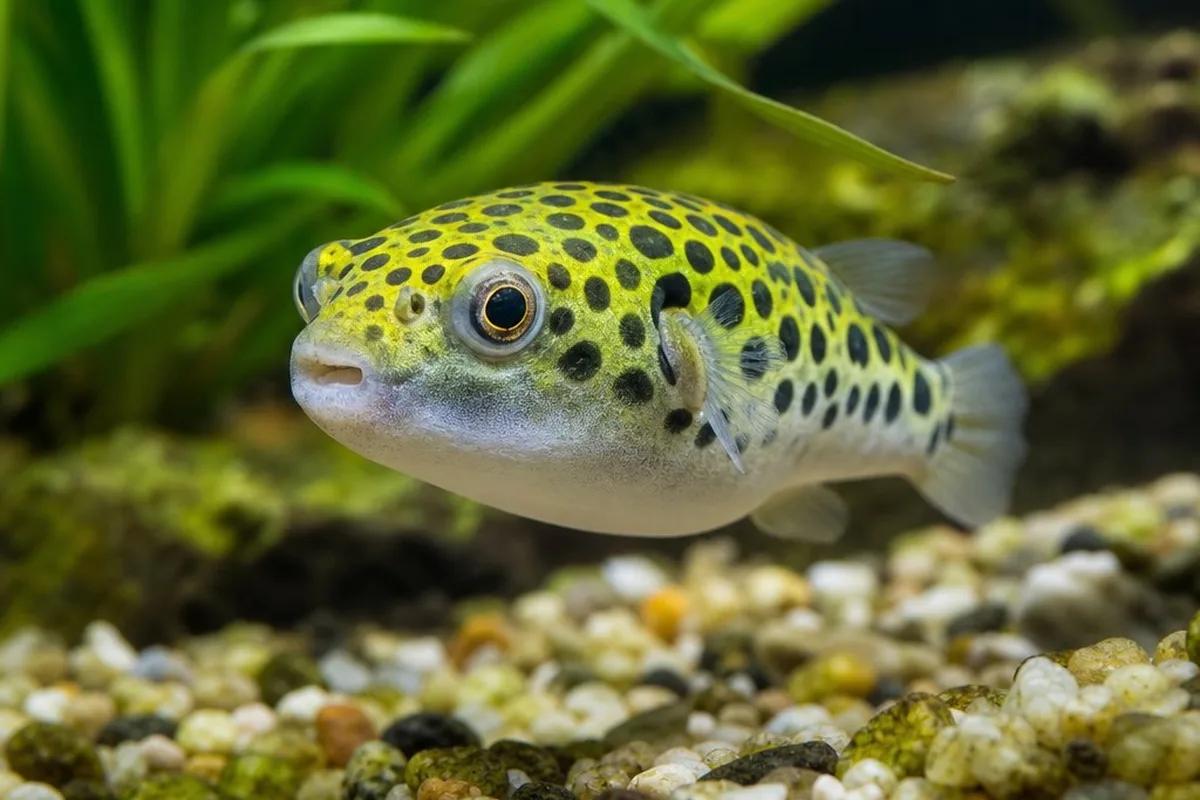
The green spotted pufferfish (Dichotomyctere nigroviridis) is a frequent example of a fish whose juvenile-stage care information doesn't tell the whole story. Sold small, often in freshwater community tank sections, GSPs are a brackish-to-marine species with continuously growing teeth and a strong tendency toward solo housing — none of which is always obvious from how they're marketed.
Appearance and Natural Range
Green spotted puffers have a distinctive yellow-green back covered in dark spots, a white belly, and the rounded, beakless-looking face typical of pufferfish. Like other puffers, they can inflate when stressed or threatened, though — as with the Valentini puffer, a different (marine) puffer species discussed elsewhere on this site — this inflation response is a stress/defense behavior, not something to encourage or trigger deliberately.
The species is native to brackish estuaries and mangrove-associated coastal waters across the Indo-Pacific, habitats where salinity varies and juveniles in particular may be found in lower-salinity zones than adults typically inhabit.
Tank Requirements
Tank Size
30 gallons is a commonly cited starting point for a juvenile, but 55+ gallons is more realistic for an adult (around 6 inches), accounting for the larger, more stable brackish-to-marine setup an adult needs and the species-only housing most keepers settle on.
Aquascaping
Live or artificial plants tolerant of brackish-to-marine conditions, smooth rocks, and hiding spots are appreciated. As salinity increases over the fish's life, plant choices may need to shift toward more salt-tolerant options or be replaced with hardscape and marine-appropriate decor.
Water Parameters
| Parameter | Target Range |
|---|---|
| Temperature | 75-82°F (24-28°C) |
| pH | 7.5-8.5 |
| Ammonia / Nitrite | 0 ppm |
| Nitrate | <20 ppm |
| Salinity (specific gravity) | Lower for juveniles (roughly 1.005-1.010), increasing toward more marine-like levels (1.015+) as the fish matures |
Diet and Feeding
Green spotted puffers are carnivores with a dietary requirement that's unusual compared to most freshwater fish:
- Snails — an excellent staple food that provides both nutrition and the hard-shell resistance needed to wear down continuously growing teeth
- Other hard-shelled foods — crustaceans (shrimp with shell on, for example) serve a similar purpose
- Variety — bloodworms and other soft foods can supplement the diet, but shouldn't replace hard-shelled foods entirely, given the dental wear consideration
Feeding a GSP without any hard-shelled foods for extended periods risks overgrown teeth, which can eventually interfere with normal feeding and may require veterinary intervention to address if it progresses far enough.
Tank Mates and Compatibility
This is the area where green spotted puffer care most often diverges from how the species is marketed. GSPs are frequently fin-nippers and generally poor community tank residents, and:
- Species-only tanks are the standard recommendation for adults
- Even other GSPs can be subject to territorial aggression in smaller setups
- Tank mates that might tolerate the salinity requirements still often don't tolerate the GSP's temperament
Planning for a solo or species-only setup from the outset — rather than discovering the issue after introducing tank mates — is the most realistic approach for this species.
Salinity Needs Change With Age
One of the most important — and most often overlooked — aspects of GSP care is that salinity requirements aren't static. Juveniles are commonly kept in lower-salinity brackish water, sometimes close to freshwater, and can appear to do well in this range for a period. However, as green spotted puffers mature, their salinity needs trend toward more marine-like conditions, and long-term health is generally better supported by gradually increasing salinity over the fish's first one to two years rather than maintaining juvenile-level salinity indefinitely.
This pattern — where a fish's needs at the size and age it's typically sold don't reflect its needs as an adult — comes up elsewhere on this site too, including with the dragon goby and its brackish requirements, and with large centerpiece fish like the red jardini arowana, where adult size dramatically exceeds what's apparent at purchase. For the broader fundamentals of brackish tank setup — salinity ranges, equipment, and other commonly mislabeled "freshwater" species — see our brackish water aquarium fish guide.
Common Health Issues
- Overgrown teeth — from insufficient hard-shelled food in the diet; can interfere with feeding if left unaddressed
- Stress from inappropriate salinity — particularly relevant for adults kept in juvenile-level (lower) salinity long-term
- Aggression-related injuries — to tank mates, or between multiple GSPs housed together without adequate space and territory
Quick Setup Checklist
- Tank: 30 gallons for a juvenile, 55+ gallons for an adult
- Plan for species-only or solo housing from the start
- Water: 75-82°F, pH 7.5-8.5, 0 ppm ammonia/nitrite
- Salinity: lower for juveniles, gradually increasing toward more marine-like levels as the fish matures
- Diet: snails and other hard-shelled foods as a regular part of feeding, not an occasional treat
- Monitor for signs of overgrown teeth if hard-shelled foods have been infrequent
- Don't assume juvenile-stage tolerance (salinity or tank mates) reflects adult needs