By Hektor Jorgo
"Biological media" gets treated as a single, interchangeable category in a lot of filter setups — fill the tray, let bacteria move in, done. Fluval BioMax and Seachem Matrix are both popular choices for that tray, and for the basic job (nitrification), the difference between them is small. Where it gets interesting is a second function that one of them is better positioned to provide.
Direct Answer: Both Nitrify Well, Matrix Adds Denitrification Potential
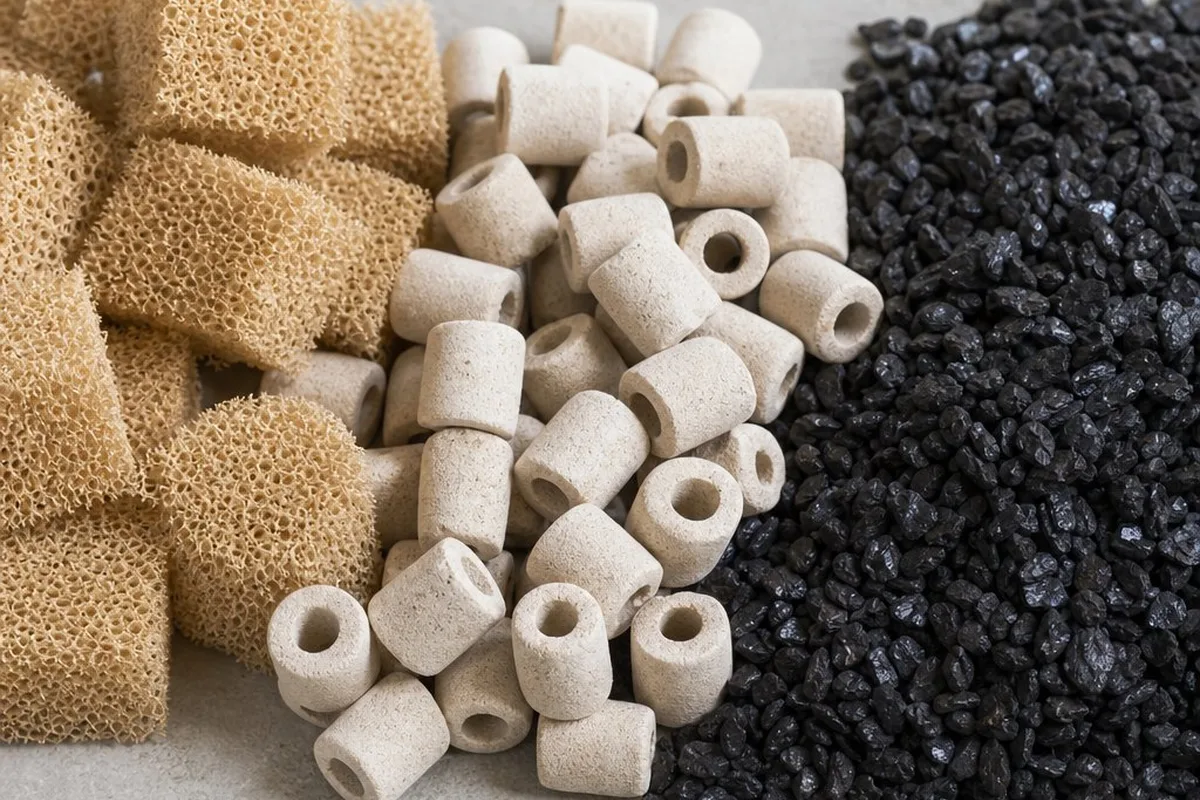
Fluval BioMax (sintered ceramic rings) and Seachem Matrix (porous rock) both provide ample surface area for nitrifying bacteria — the bacteria that convert ammonia to nitrite and nitrite to nitrate — and for that core function, either works well. The meaningful difference is pore structure: Matrix's larger, deeper pores can develop low-oxygen zones inside each piece, where a different group of bacteria can perform denitrification — converting nitrate into nitrogen gas. BioMax's finer, more uniform structure is less suited to forming these zones, making it primarily a nitrification media. Whether Matrix's denitrification benefit is significant in practice depends on flow rate — it works best when water moves through the media slowly enough for an oxygen gradient to form.
Nitrification: Where Both Media Excel
Nitrifying bacteria — Nitrosomonas (ammonia to nitrite) and Nitrospira/Nitrobacter (nitrite to nitrate) — need oxygen-rich surfaces to colonize and work efficiently. Both BioMax's ceramic structure and Matrix's rock structure provide plenty of this kind of surface area, which is why either media is a reasonable, effective choice for the basic job of keeping ammonia and nitrite at zero in an established tank. If you're troubleshooting a filter that seems to be struggling with ammonia/nitrite after maintenance, that's more often a media-disruption issue than a media-type issue — covered in our guide on filters not working right after cleaning.
Denitrification: Where Matrix's Pore Structure Matters
This is the feature that distinguishes Matrix in marketing and in practice. As water flows past and into a porous piece of media, bacteria near the surface consume oxygen from that water. In a piece with large, deep pores, oxygen gets used up faster than it can diffuse to the center — creating an anaerobic (oxygen-depleted) core. In that environment, denitrifying bacteria can convert nitrate (NO₃⁻) into nitrogen gas (N₂), which escapes into the atmosphere rather than accumulating in the water.
This is a genuinely different mechanism from nitrification, and it's the reason Matrix is sometimes described as supporting "the full nitrogen cycle" rather than just the ammonia/nitrite portion. The caveat is that this effect scales with flow conditions — water needs to move through the media slowly enough for that internal oxygen gradient to actually form. In a high-flow canister filter, where water is pushed through media relatively quickly, the effect is likely more modest than in a slower-flow sump tray.
How This Compares to Other Filtration Stages
It's worth placing this in context with the rest of a filter's media stack:
- Mechanical media (filter floss, covered in our cotton wool / filter floss guide) removes particulates — it doesn't touch dissolved ammonia, nitrite, or nitrate at all.
- Fine polishing media like the clarifying media in our CaribSea Bio-Magnet review targets fine particulates that floss misses — again, a different job from biological media entirely.
- Wet/dry biological media (bio-balls, covered in our Amiracle wet/dry filter review) takes the opposite approach from Matrix — maximizing oxygen exposure for nitrification, with little to no anaerobic zone for denitrification. It's a useful contrast: bio-balls and Matrix sit at opposite ends of the "oxygen exposure" spectrum, each suited to a different part of the nitrogen cycle.
Mixing Media: A Common Middle Ground
Because BioMax and Matrix are both inert and occupy the same general filter stage, running both together is a common approach — BioMax (or similar ceramic media) for reliable nitrification capacity, plus some Matrix for its additional denitrification potential where flow conditions allow. For most moderately stocked tanks, either media alone is sufficient for the core nitrogen cycle, and the choice between them — or whether to mix — comes down to how much weight you put on the modest, flow-dependent denitrification benefit Matrix offers.
Quick Reference
- Both BioMax and Matrix provide ample surface area for nitrifying bacteria — the core function either handles well
- Matrix's larger pore structure can develop anaerobic zones supporting denitrification (nitrate reduction)
- BioMax's finer, more uniform structure is primarily suited to nitrification, not denitrification
- Matrix's denitrification benefit depends on flow being slow enough for an internal oxygen gradient to form
- Mixing both media types in one filter is common and has no compatibility issues
- Neither media replaces water changes — both reduce, but don't eliminate, nitrate accumulation
- Choice between them matters less for nitrification than for the optional denitrification benefit