By Hektor Jorgo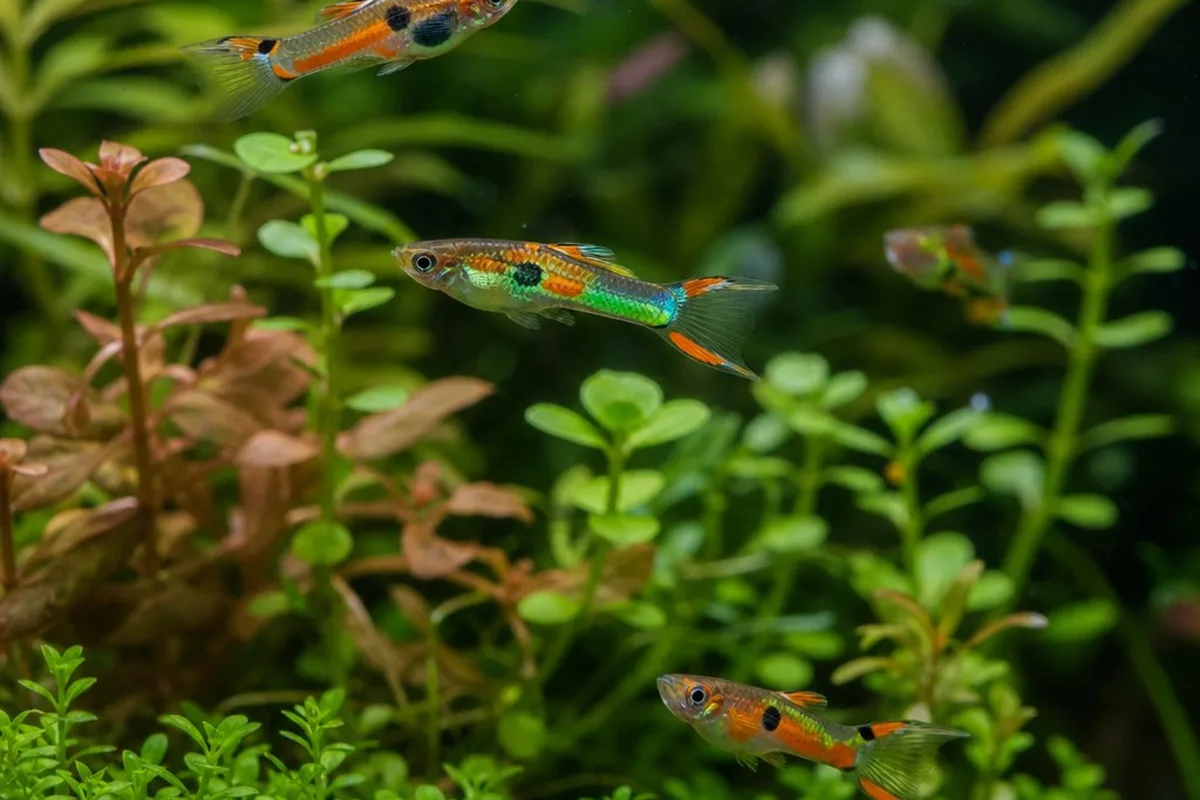
Endler's livebearers are frequently recommended as nano-tank fish, and a quick look at their adult size makes a 5-gallon tank seem like an obvious fit. The size math isn't wrong — but it leaves out the part of Endler's biology that matters most for a small tank: how quickly the population can grow, and what that does to a tank with very little bioload margin to begin with.
Short Answer
A 5-gallon tank can physically house a small group of Endler's livebearers (Poecilia wingei), which are typically only 1-1.5 inches as adults. The bigger question is whether the setup can stay stable over time — Endler's breed readily, and a mixed-sex group in a planted 5-gallon tank can see its population grow steadily, pushing bioload past what a small water volume and modest filtration can comfortably absorb. A males-only group sidesteps this issue entirely and is the more straightforward way to keep Endler's in a tank this size long-term; a mixed-sex group is workable but requires more active management.
About Endler's Livebearers
Poecilia wingei is closely related to the common guppy (Poecilia reticulata) — closely enough that the two can interbreed in some circumstances, a consideration also relevant to other livebearer pairings discussed on this site, like sailfin and shortfin molly hybridization. Endler's are generally smaller than guppies, with males often displaying particularly vivid and varied coloration, which is a large part of why they're popular for small, visible tanks.
In terms of day-to-day care — water parameters, diet, general hardiness — Endler's track closely with what's described in our guppy care guide: an omnivorous diet, tolerance for a range of water hardness (generally doing well in moderately hard, neutral-to-slightly-alkaline water), and a generally easygoing temperament.
Why 5 Gallons Is a Borderline Size
The issue with a 5-gallon tank isn't the fish's size — it's the margin for error. Every aquarium has some capacity to absorb fluctuations: a slightly-too-large feeding, a missed water change, a brief filter hiccup. That margin scales with water volume, and a 5-gallon tank simply has less of it than a 10, 20, or 29-gallon tank holding the same number of fish.
For most small fish kept in stable numbers, this is manageable with attentive maintenance. The complication with Endler's specifically is that the number of fish isn't necessarily stable — which leads to the next section.
The Breeding Problem in Small Tanks
Endler's livebearers, like guppies, breed readily when males and females are kept together, and they do so continuously rather than in a single seasonal event. In a planted tank with hiding spots, at least some fry typically survive to adulthood, and those fry are themselves capable of breeding within a few months.
In a larger tank, this is often viewed as a feature — a self-sustaining, ever-changing population of small, colorful fish. In a 5-gallon tank, the same dynamic means that a tank stocked appropriately on day one can become overstocked within a few months without any change in feeding habits or maintenance routine, simply because the fish population grew. This is a different kind of bioload creep than the diet-and-waste-volume bioload discussed for plecos in our pleco waste guide — here, the "bioload" itself is multiplying.
Making a 5-Gallon Endler Tank Work
If a 5-gallon tank is the constraint you're working with:
- Consider a males-only group. This removes the breeding-population problem entirely, while still allowing you to enjoy Endler's well-known male coloration — arguably the main draw of the species for many keepers anyway.
- If keeping a mixed-sex group, plan for fry management from the start — rehoming fry regularly, or accepting that natural attrition (including some predation in a community setup) will need to do more of the population control than it would in a larger tank.
- Increase your water-change frequency beyond what a 5-gallon tank might otherwise need for a stable, non-breeding population — the smaller the water volume, the faster waste from an expanding population affects water quality.
- Heavily plant the tank, both for some nutrient uptake and for fry survival — though recognize this works somewhat against population control in a mixed-sex setup, so it's most useful in a males-only tank or one where you've made peace with ongoing fry management.
- If the population becomes difficult to manage, moving some fish to a larger tank (10+ gallons) gives meaningfully more bioload margin for the same fish, without requiring a change in the fish themselves.
Quick Reference
- Endler's livebearers (Poecilia wingei) are small (1-1.5 inches) and physically fit a 5-gallon tank
- The real constraint is bioload margin, not fish size
- Mixed-sex groups breed continuously — population can grow past what 5 gallons can support
- Males-only groups avoid the breeding-population problem entirely
- Mixed-sex setups need active fry management and more frequent water changes
- Heavy planting helps water quality but also helps fry survive (works against population control)
- A 10+ gallon tank gives meaningfully more margin for the same fish