By Hektor Jorgo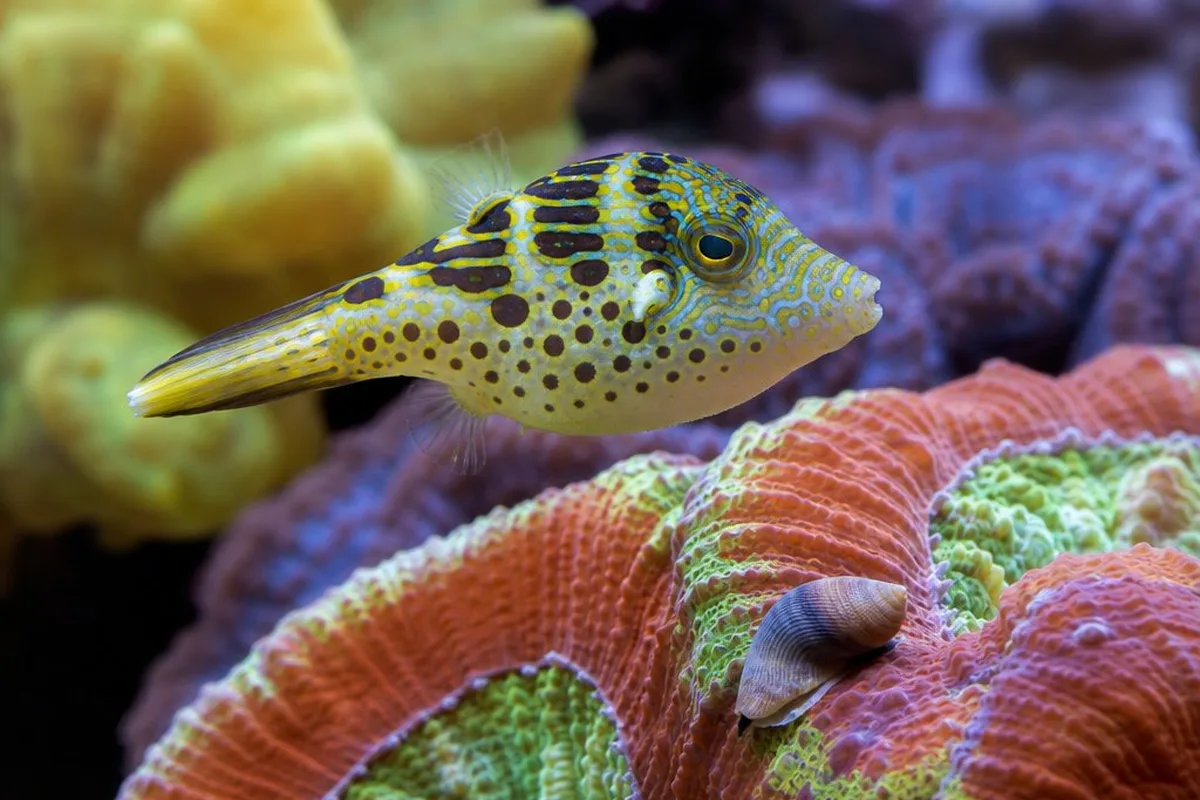
The Valentini puffer (Canthigaster valentini) is one of the most frequently asked-about fish when it comes to reef compatibility, and for good reason — it's small, attractively patterned, reasonably priced, and tempting to add to almost any setup. The short version: it's a meaningfully better bet for corals than for your cleanup crew. Most Valentini puffers leave SPS and soft corals alone, LPS corals carry a real but inconsistent risk, and clam mantles and small invertebrates — snails, crabs, shrimp — are where this species earns its reputation as a problem fish in a reef tank.
Short Answer
The Valentini puffer is not a reliable reef-safe fish, but the risk profile is uneven across livestock types. SPS and most soft corals are generally safe. LPS corals carry moderate, individual-dependent risk. Tridacnid clams are at high risk of mantle nipping. And snails, hermit crabs, and small ornamental crustaceans — the backbone of most reef cleanup crews — are at consistently high risk, because eating hard-shelled invertebrates is close to instinctive for this species, not just an occasional bad habit some individuals develop.
If your reef tank has a substantial cleanup crew of snails and crabs, or a clam you care about, a Valentini puffer is one of the more predictable ways to lose that livestock over time. If your tank is coral-focused with minimal invertebrate cleanup crew and no clams, the picture is considerably better — though still not a guaranteed yes.
What a Valentini Puffer Eats and Damages
Snails, hermit crabs, and small crustaceans — the biggest risk
This is the single most consistent reef-safety issue with Canthigaster valentini, and it's worth separating from the coral question entirely because the underlying behavior is different. Corals are an occasional, individually variable target. Snails, hermits, and small crabs are natural prey — in the wild, hard-shelled invertebrates make up a substantial part of this species' diet, and its fused beak-like teeth (covered in detail in our pufferfish care guide) are specifically adapted for crushing shells.
In practice, this means:
- Turbo snails, Astraea snails, Nassarius, and similar cleanup-crew staples are routinely hunted and eaten, often within days of the puffer settling in
- Hermit crabs are a particular favorite — the puffer can crack into the shell to get at the crab inside
- Small ornamental shrimp (cleaner shrimp, peppermint shrimp, fire shrimp) are at risk, especially smaller or juvenile individuals, though larger established shrimp sometimes fare better
- Bristleworms and other rock-dwelling invertebrates are also fair game, which some reefers consider a plus depending on bristleworm population levels
If you're relying on a snail-and-crab cleanup crew to manage algae and detritus, expect that population to decline steadily after adding a Valentini puffer — this isn't a "some individuals do this" caveat, it's close to a species norm.
Clam mantles — high risk
Tridacnid clams (Tridacna species — derasa, maxima, crocea, squamosa) are frequently reported as targets. The puffer picks at the exposed, fleshy mantle tissue that the clam extends when open. A clam that's repeatedly targeted will respond by keeping its mantle retracted and staying closed for extended periods, which reduces its ability to photosynthesize (most tridacnids host photosynthetic zooxanthellae and need mantle exposure to light) and feed. Over weeks, sustained harassment can lead to a clam's decline even without a single fatal bite.
If a clam is a display centerpiece in your tank, a Valentini puffer introduces a real and fairly well-documented risk to it — this is one of the clearer "don't" combinations in reef-tank stocking.
LPS corals — moderate, individual-dependent risk
Large-polyp stony corals — euphyllia (hammer, frogspawn, torch), acans, and similar fleshy-polyped species — are occasionally reported as targets, with some individual puffers picking at extended polyps the same way they might investigate any soft, fleshy structure. This is meaningfully less consistent than the invertebrate-predation behavior above; many Valentini puffers never bother LPS corals at all, while others will repeatedly target the same colony.
Zoanthids and palythoa occasionally get sampled as well, though less consistently than by dedicated polyp-pickers like some butterflyfish or the flame angelfish, which carries a broadly similar "proceed with caution" reputation for LPS and clam mantles.
What's Generally Safe
The better news: SPS corals (Acropora, Montipora, etc.) and most soft corals (leathers, mushrooms, xenia, zoanthid-free soft coral colonies) are generally left alone by Valentini puffers. These corals don't present the same fleshy, extended-polyp profile that seems to draw attention from individuals that do pick at LPS or clams, and reports of SPS or soft coral damage from this species are uncommon.
This means a reef tank that's SPS- and soft-coral-dominant, with no clams and a minimal snail/crab cleanup crew, is a meaningfully different — and better — proposition for a Valentini puffer than a mixed reef with a full cleanup crew and a clam collection. The fish itself doesn't change; the stakes do.
Individual Variation — and Where It Doesn't Apply
Reef-safety discussions for many fish (the flame angelfish is a good comparison point) hinge heavily on "it depends on the individual" — some fish never touch corals, others develop a habit, and there's no reliable way to predict which you've got until after the fact.
That framing applies to Valentini puffers too, but unevenly. For LPS coral-picking, individual variation is real and significant — plenty of Valentini puffers never touch a euphyllia frag, while others target one repeatedly. For snails, crabs, shrimp, and clam mantles, though, the variation is much narrower — the overwhelming majority of Valentini puffers will eat hard-shelled invertebrates and pick at clam mantles given the opportunity, because this is closer to instinctive feeding behavior than an acquired taste for coral tissue. Don't bank on getting "one of the good ones" when it comes to your cleanup crew.
It's also worth noting that fish-versus-invert risk is a different question from fish-versus-fish compatibility. A Valentini puffer can coexist peacefully with other fish — including clownfish — while still being a serious problem for your snails and shrimp. If you're specifically weighing whether a Valentini puffer works alongside clownfish and other livestock together, see our breakdown on keeping Valentini puffers and clownfish in the same tank, which covers the fish-compatibility side separately from the invert risk discussed here.
Reducing the Risk
There's no way to make a Valentini puffer fully reef safe for snails, crabs, and clams — but you can stack the odds in your favor for corals and limit your exposure on the invert side:
- Don't build around a cleanup crew if you're adding a Valentini puffer. Accept that snail- and crab-based cleanup crews and this fish don't coexist well long-term. If you need substrate and algae management, look toward cleanup methods less attractive to the puffer (larger, more established crabs that can defend themselves, or manual maintenance) rather than a typical small-snail army.
- Skip the clams, or accept the risk going in. If a Tridacna clam is a must-have for your display, a Valentini puffer is one of the fish to rule out rather than gamble on.
- Feed heavily and on a hard-shell-rich rotation. A well-fed puffer that's regularly getting snails, crab/shrimp shells, and other hard foods (as covered in our pufferfish care guide) is less likely to go looking for alternative food sources among your LPS corals — though this won't protect existing cleanup-crew inverts, since hunting them isn't purely hunger-driven.
- Lean SPS and soft coral for your coral selection. If reef-safety odds matter to your stocking plan, building the coral side of the tank around SPS and soft corals — and away from LPS, zoanthids, and clams — removes most of the coral-related uncertainty.
- Watch new additions closely for the first few weeks. If you add new snails, crabs, or shrimp to an established tank with a Valentini puffer already present, expect them to disappear quickly — this isn't a "wait and see" situation the way LPS-picking sometimes is.
Quick Reference
- SPS corals: generally safe
- Soft corals (leathers, mushrooms, xenia): generally safe
- LPS corals (euphyllia, acans, zoanthids): moderate risk, varies by individual
- Tridacnid clams: high risk to mantle — avoid if clam is a priority
- Snails (turbo, Astraea, Nassarius, etc.): high risk — expect losses
- Hermit crabs: high risk — frequent target
- Ornamental shrimp: moderate to high risk, especially smaller individuals
- Best stocking plan: SPS/soft-coral-dominant reef, no clams, minimal snail/crab cleanup crew