By Hektor Jorgo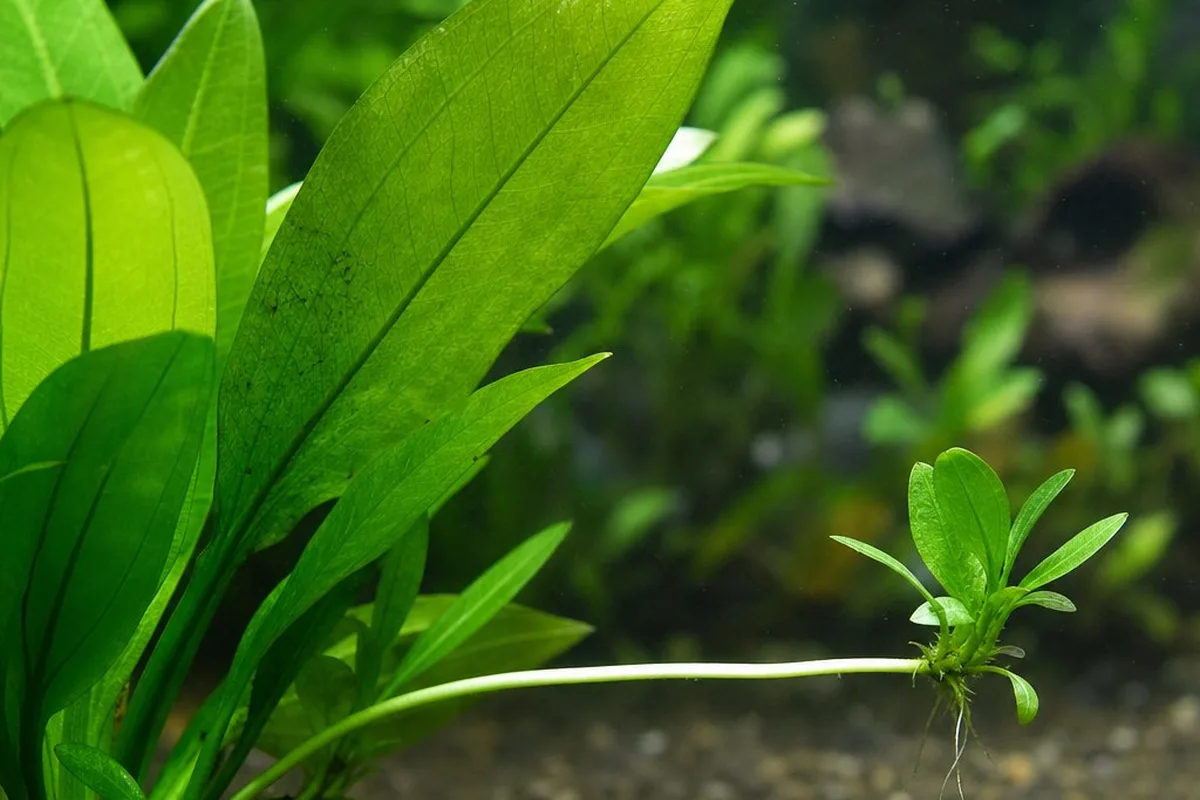
Most plant "problems" people ask about are things going wrong. A runner on an Amazon sword is the opposite — it's the plant doing exactly what a healthy, established Echinodorus does once it's settled in. If you've spotted a long stem trailing out from the base of your sword plant with a tiny new plant forming at the end, you're looking at free propagation, not trouble.
Direct Answer: Runners Are a Sign of a Healthy, Mature Plant
A runner (botanically, a stolon) is a horizontal stem that an Amazon sword sends out from its base once it's established and growing well. At the tip — or sometimes at points along its length — the runner produces a plantlet: a small new plant with its own developing leaves and roots, initially supported by the parent plant through the runner connection. Seeing this happen is generally a positive sign about your tank's conditions (light, substrate nutrients, and overall plant health), similar in spirit to how hornwort's tendency to grow vigorously is a sign of a fast, healthy-growing plant rather than a problem to manage. A sword mature enough to runner is also typically well past the initial cycling period where fast-growing plants help manage ammonia and nitrite — by this stage, root feeders like swords are contributing to the tank's overall nutrient balance rather than competing for the same water-column ammonia.
What Runners Look Like and How They Develop
A runner starts as a thin stem extending horizontally from the base of the sword plant, often along or just above the substrate. As it grows, a cluster of small leaves begins forming at the tip (or occasionally at a node partway along the stem) — this is the plantlet. Over time, the plantlet develops its own root system reaching down into the substrate, while still receiving some support from the parent plant via the runner. It's not unusual for a single runner to produce more than one plantlet along its length if conditions are favorable, though one plantlet per runner is more typical.
When and How to Separate Plantlets
The key signal for separation readiness is the plantlet's own development — specifically, several leaves of its own and visible roots reaching into the substrate. A plantlet separated too early, before it can support itself, has a lower chance of establishing well as an independent plant. Once it's ready:
- Using clean scissors, cut the runner stem on both sides of the plantlet's root mass, close to the plantlet
- Carefully lift the plantlet, keeping its root system as intact as possible
- Plant it in substrate elsewhere in the tank (or a different tank), with the crown at or just above the substrate surface
- The remaining stub of runner on the parent plant will typically wither and can be trimmed away
Planting Separated Plantlets
Amazon swords are root-feeding plants, meaning a nutrient-rich substrate matters more for them than for plants that primarily absorb nutrients through their leaves from the water column — our plant substrate guide covers this distinction in more depth, and our guide to laterite covers a traditional iron-rich substrate additive that root feeders like swords (including separated plantlets) respond well to. When replanting a separated plantlet, give it a spot with reasonable substrate depth, since its root system — though smaller than the parent's — will continue to grow and needs room to do so. As with the parent plant, avoid burying the crown itself; only the roots and the very base of the plant should be below the substrate surface. In a larger setup like a 75-gallon planted tank, separated plantlets are a convenient way to fill out a root-feeder zone without buying additional plants.
Why Some Swords Don't Produce Runners
Not every healthy Amazon sword sends out runners, and their absence isn't necessarily a concern. Many swords reproduce primarily through flower stalks — a tall stem that grows up toward (and often above) the water surface, which can flower and also produce plantlets along its length, particularly in tanks with bright lighting and an open or low-coverage top. Some plants simply don't runner much regardless of conditions. If your sword is otherwise growing well — pushing new leaves regularly, holding good color, with a healthy root system — the lack of runners specifically isn't something to troubleshoot. It's only worth investigating if the plant shows signs of poor growth more broadly (stunting, pale or yellowing leaves, no new growth at all), which points to a different underlying issue with light or substrate nutrients rather than propagation method.
Quick Reference
- A runner is a horizontal stem producing a new plantlet — a sign of a healthy, mature plant
- Wait until the plantlet has its own leaves and roots before separating
- Cut the runner stem close to the plantlet on both sides, then replant normally
- Don't bury the plantlet's crown when replanting, same as the parent
- No runners doesn't mean a problem — many swords propagate via flower stalks instead
- Multiple plantlets on one runner are possible under good conditions
- Overall plant health (new leaves, good color, root growth) matters more than runner production specifically