By Hektor Jorgo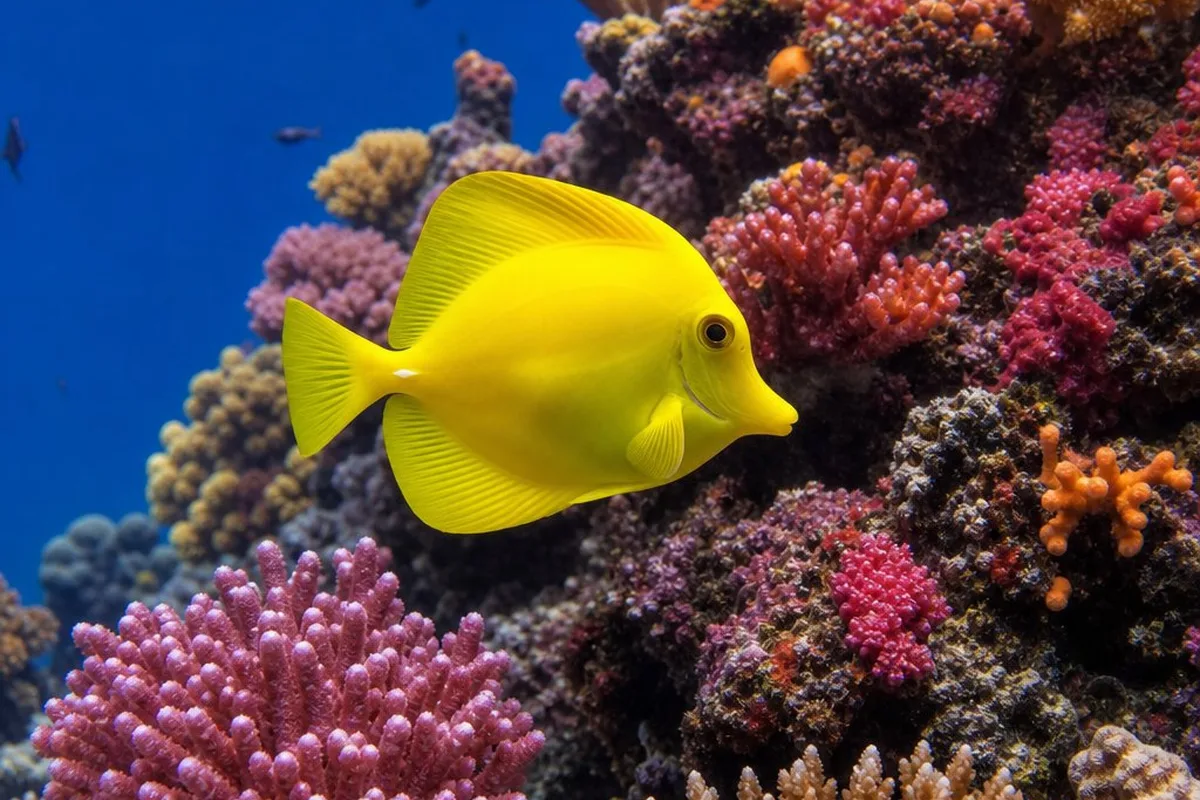
A bright, almost cartoonishly yellow fish gliding over a Hawaiian reef is one of those images that shows up constantly in photos, posters, and aquarium-store displays — and in nearly every case, that fish has a specific name and a fairly interesting backstory in the aquarium world.
Short Answer
The fish most people picture when they think of "the yellow fish in Hawaii" is the yellow tang (Zebrasoma flavescens) — an oval-bodied surgeonfish that's almost entirely solid bright yellow from nose to tail, with a small mouth and elongated snout typical of tangs. While its natural range covers the broader Indo-Pacific, Hawaii has historically been a major source region for yellow tangs in the aquarium trade, and the species has become closely associated with Hawaiian reefs both because of its presence there and because of its prominence in aquarium-trade discussions involving Hawaiian collection.
What Makes the Yellow Tang So Recognizable
Unlike many reef fish with intricate patterns, stripes, or multi-color combinations, the yellow tang's coloration is strikingly simple — essentially uniform bright yellow across the entire body, with minimal additional markings. Combined with the characteristic oval, laterally flattened body and elongated snout shared by tangs and surgeonfish generally, this gives the yellow tang a silhouette and color combination that's genuinely easy to recognize even from a distance or in a low-quality photo — part of why it's become such an iconic image of reef life.
Hawaii's Aquarium Trade Connection
The yellow tang's association with Hawaii goes beyond its natural presence in Hawaiian waters — the species has also been a central figure in ongoing discussions about aquarium fish collection regulations in Hawaii, given how significant a role the species has played in the aquarium trade and the attention that's brought to collection practices more broadly. These discussions involve a mix of conservation considerations, the aquarium trade's demand, and the livelihoods of people involved in collection — a genuinely complex topic, and one where current regulations are best checked against up-to-date official sources rather than general articles, since rules and their enforcement have changed over time. What's relevant here is simply that this attention is part of why the yellow tang is so strongly linked to Hawaii in popular awareness, on top of the species' natural range and appearance.
Not the Only Yellow Fish on the Reef
While the yellow tang is probably the most likely answer to "what's that yellow fish," it's far from the only yellow reef fish. Various butterflyfish and damselfish species have substantial yellow coloration, and juvenile color forms of some species are yellow even when the adults look quite different. The foxface rabbitfish is another reef fish with prominent yellow coloration that can get mentally grouped into the same "yellow reef fish" category. The yellow tang's near-total, unbroken yellow coloring and distinctive tang body shape are generally the most reliable cues for telling it apart from these other species.
What to Know Before Keeping One
As a tang/surgeonfish, the yellow tang generally needs more swimming room than its modest adult size might suggest, along with regular access to algae for grazing, since algae makes up a meaningful part of its natural diet. It also carries the defensive tail spine typical of surgeonfish, worth keeping in mind during handling or netting. None of this makes the species especially difficult — it's a long-standing aquarium trade staple precisely because it tends to do well given appropriate space — but its needs are real and worth planning for rather than assuming a "small-looking" fish has correspondingly small requirements.
Quick Reference
- The "yellow fish" commonly associated with Hawaii is almost always the yellow tang (Zebrasoma flavescens)
- Recognizable by its nearly uniform solid yellow body and oval tang-shaped silhouette
- Natural range covers the broader Indo-Pacific; Hawaii has been a major aquarium-trade source region
- The species has been central to ongoing debates over Hawaii's aquarium collection regulations
- Other yellow reef fish (certain butterflyfish, damselfish, juveniles) can cause identification confusion
- As a tang/surgeonfish, it needs more swimming space and algae-grazing opportunities than its size suggests
- Carries a sharp defensive tail spine typical of surgeonfish