By Hektor Jorgo
"Why does my goldfish look deformed?" is a question that covers two very different situations — one where the answer is "that's just what this variety looks like," and one where the answer is "something has changed, and it's worth looking into." Telling them apart starts with a simple question: has the fish always looked this way?
Short Answer
If a goldfish has consistently had an unusual body shape, eye shape, or fin pattern since you've known it, it's most likely a fancy goldfish variety (ranchu, lionhead, bubble eye, celestial eye, and others) — these traits are the result of selective breeding and represent the intended appearance of that variety, not a current problem. Some of these bred traits, particularly very rounded body shapes, are associated with a higher likelihood of swim bladder issues, which is a genuine welfare consideration when choosing a variety — but that's different from a fish that recently developed a new shape, posture, or swimming pattern after previously looking and swimming normally. A recent change points toward an active issue (often swim bladder disease) rather than a breed characteristic.
Selective Breeding: When "Deformed" Is the Intended Look
Goldfish (Carassius auratus) have been bred for hundreds of years into an enormous range of "fancy" varieties, many of which look dramatically different from the more familiar elongated, single-tailed common goldfish or comet. Examples include:
- Ranchu and lionhead: rounded, egg-shaped bodies without a dorsal fin, and in lionhead's case, a raspberry-like growth ("wen") on the head
- Bubble eye: large, fluid-filled sacs beneath the eyes
- Celestial eye: eyes that point upward rather than to the sides
- Various fin and scale variations: extended, curled, or doubled fins; metallic, nacreous, or matte scale types
To someone unfamiliar with these varieties, several of these traits could reasonably look like "deformities" — and in a sense, from the perspective of a wild-type goldfish, they are dramatic departures from the "default" body plan. But for these varieties, that departure is the variety — a ranchu goldfish without its characteristic rounded, finless back wouldn't be a ranchu.
Welfare Considerations With Fancy Goldfish Body Shapes
It's worth being honest that this isn't purely a matter of aesthetics with no functional cost. Some fancy goldfish traits — particularly the very rounded, compressed body shapes seen in varieties like ranchu and lionhead — have been associated with higher rates of swim bladder issues, since the internal organs, including the swim bladder, are arranged in a body cavity shaped quite differently from the more elongated common goldfish.
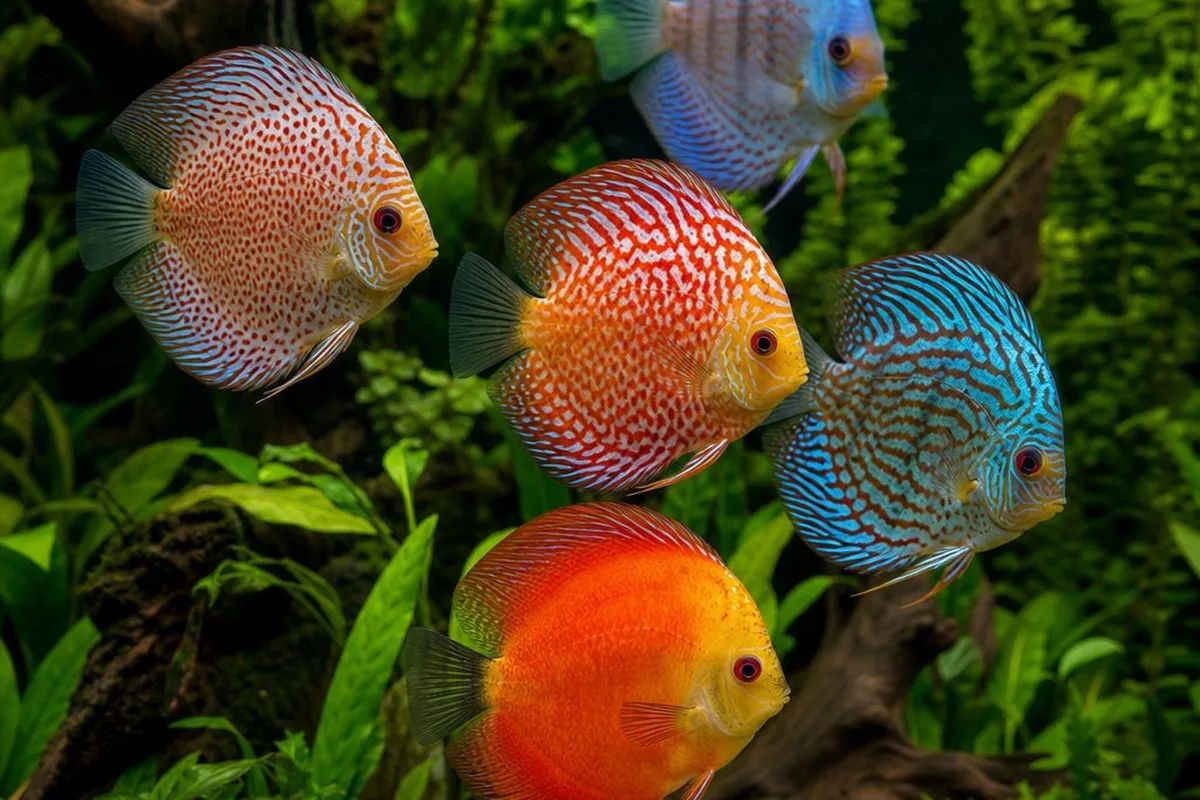
This is part of a broader pattern in ornamental fish breeding where traits selected for appearance can carry functional tradeoffs — a dynamic that, in a different context, is also worth considering with the unusually tall, disc-shaped body of discus, though discus body shape hasn't been pushed to the same extremes through breeding as some fancy goldfish varieties. None of this means every individual fancy goldfish will develop problems, but it's a legitimate factor in choosing a variety, and in understanding why fancy goldfish as a group are sometimes discussed as needing more attentive care than hardier common goldfish or koi.
When It's Not Breeding: Illness and Injury-Related Deformities
The situation that's actually worth investigating is a change from a previous baseline — a goldfish that swam normally for months or years and then develops:
- Abnormal buoyancy — floating at the surface, sinking to the bottom, or swimming at an unusual angle
- Swimming upside down or sideways
- A new curve or angle to the body that wasn't there before
These are commonly associated with swim bladder disease — a condition (not a breed trait) affecting the organ goldfish use to control their position in the water. Causes can include overfeeding, constipation, bacterial infections, or in some cases congenital issues that become apparent over time even in fish that initially seemed normal.
Spinal curvature can also result from injury or, in some cases, other underlying health conditions — a pattern that, in a different species, echoes how advanced neon tetra disease can eventually produce visible spinal changes as a symptom of an underlying parasitic condition, despite starting from a completely different cause.
How to Tell the Difference
The practical approach is the same one that comes up repeatedly across fish health topics on this site — compare against a baseline:
- Has this body shape, eye shape, or fin pattern been present since you got the fish? If yes, and it matches a known fancy variety's traits, it's very likely just that variety's normal appearance.
- Has something changed recently — particularly swimming ability, buoyancy, or posture? This points toward an active issue rather than a breed characteristic.
- Is the "deformity" affecting function — can the fish swim, feed, and maintain normal position in the water, or is it struggling? A fancy variety's unusual appearance doesn't necessarily mean impaired function, while a fish struggling to swim or maintain position — regardless of its body shape — warrants closer attention.
This baseline-comparison approach mirrors the scale-texture check in our bloated cory catfish guide (flat scales = likely normal bloating, raised "pinecone" scales = possible dropsy) — in both cases, a specific, checkable detail does more to clarify the situation than the general impression of "something looks off." Note that all of this is about body shape — if what's changed is the texture of the skin itself (a patch that looks like it's lifting, peeling, or developing a sore), that's a different issue covered in our goldfish skin peeling guide.
Quick Reference
- A consistent, lifelong body/eye/fin shape matching a known fancy variety is likely normal for that variety
- Very rounded fancy goldfish body shapes are associated with higher swim bladder issue rates — a real consideration when choosing a variety
- A recent change in shape, posture, or swimming ability points toward an active issue, not a breed trait
- Abnormal buoyancy/floating/sinking is commonly linked to swim bladder disease
- Spinal curvature can result from injury or underlying health conditions, separate from bred body shapes
- Compare against the fish's own baseline — "always like this" vs. "recently changed" is the key question
- Function (swimming, feeding, position control) matters more than appearance alone