By Hektor Jorgo
"Pufferfish" is a deceptively broad term in the saltwater hobby — it covers everything from this 4-inch reef dweller to porcupine puffers (Diodon species) that can outgrow a 180-gallon tank and grow nearly a foot and a half long. Before you buy anything labeled "puffer" at your local fish store, it's worth confirming exactly which species you're looking at, because the care requirements between a Valentini puffer and a porcupine puffer are not remotely interchangeable. This guide focuses on the Valentini puffer, also called the saddled puffer or saddle toby (Canthigaster valentini) — by far the most commonly available, most reasonably sized, and most realistic pufferfish option for a standard home reef or FOWLR tank.
The Valentini puffer is a genuinely charismatic fish: curious, food-motivated, and full of personality in a way that few other small reef fish match. It's also a fish with a couple of biological quirks — its famous ability to inflate when threatened, and a set of continuously growing, beak-like teeth — that directly shape how you need to care for it. Get those two things right, along with a sensible approach to tank mates, and a Valentini puffer can be a long-lived, engaging centerpiece fish.
Appearance and Natural Range
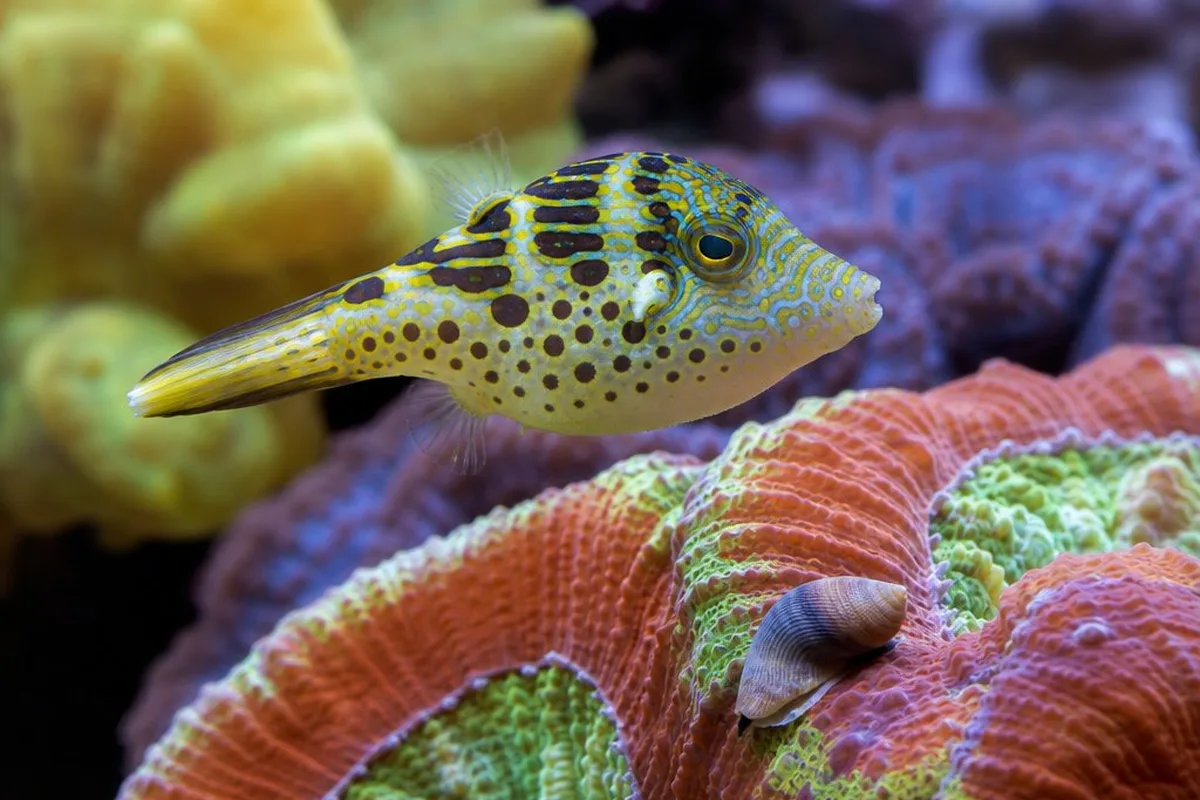
The Valentini puffer gets its common names — saddled puffer, saddle toby — from the two or three large dark brown "saddle" markings that sit across its back and sides on an otherwise white-to-pale-tan body. Fine dark lines radiate from the eyes, and the fins often carry a yellow or orange tint, particularly on the dorsal and caudal fins. Adults max out around 5 inches (13 cm), making it one of the smallest pufferfish regularly seen in the trade — a fraction of the size of a porcupine or dogface puffer.
One notable quirk: Canthigaster valentini is part of a well-documented mimicry relationship with the black saddleback toby (Canthigaster valentini itself is often confused with, and in some regions co-occurs with, the related Paraluteres prionurus, a filefish that mimics the puffer's pattern almost exactly). The mimic filefish copies the puffer's coloration because predators learn to avoid the toxic original — a textbook example of Batesian mimicry that's worth knowing about if you're trying to confirm you've actually bought a puffer and not a filefish.
In the wild, C. valentini is found throughout the Indo-Pacific, from the Red Sea and East Africa across to the Pacific islands, typically on shallow reef flats, lagoons, and seagrass beds at depths of 1-25 meters. It's an opportunistic feeder there, picking at algae, sponges, tunicates, hard-shelled invertebrates, and coral polyps — a diet that maps directly onto what it needs in captivity.
Tank Requirements
Tank Size
A single Valentini puffer needs a minimum of 55 gallons (210 liters). While the fish itself stays under 5 inches, it's an active, inquisitive swimmer that covers a lot of ground and produces a surprising amount of waste for its size — bioload from a puffer's diet of meaty, hard-shelled foods adds up quickly. Smaller tanks also concentrate stress: a puffer that doesn't have room to retreat from real or perceived threats is more likely to inflate repeatedly, which (as covered below) is genuinely harmful over time. If you're planning a reef tank with a Valentini puffer as a feature fish, 75+ gallons gives you more room for both the puffer's activity level and a thoughtful tank mate lineup.
Aquascaping
Valentini puffers like a mix of open swimming space and structure. In the wild they patrol reef flats and rubble zones rather than hiding in dense caves all day, so while some rockwork with hiding spots is appreciated (especially for a newly introduced fish that's still settling in), you don't need to build a maze. What matters more is a sandy or fine-substrate area — puffers will often forage through sand looking for buried invertebrates, and this natural foraging behavior is good enrichment.
Keep an eye on equipment placement too. Puffers are curious and will investigate powerheads, overflow boxes, and any gaps in the rockwork. Make sure intakes are screened and there are no narrow crevices a curious puffer could wedge itself into — their body shape doesn't reverse out of tight spots easily.
Water Parameters
| Parameter | Target Range |
|---|---|
| Temperature | 74-80°F (23-27°C) |
| Salinity | 1.022-1.025 SG |
| pH | 8.1-8.4 |
| Ammonia / Nitrite | 0 ppm |
| Nitrate | <20 ppm |
| Alkalinity | 8-11 dKH |
Valentini puffers are reasonably hardy once acclimated and tolerate normal reef-tank parameter swings better than many small reef fish. Where they're less forgiving is water quality related to their bioload — because they're fed meaty foods and shell material, uneaten food and waste can accumulate quickly if filtration and maintenance don't keep pace. Stay on top of nitrate, in particular, since elevated nitrate is a common contributor to skin and fin issues in puffers.
Diet and Feeding
This is the single most important section of this guide, because getting it wrong has consequences that go beyond "the fish looks thin."
Valentini puffers, like all members of the order Tetraodontiformes, have fused, beak-like teeth that grow continuously throughout their lives. In the wild, this beak is constantly worn down by crunching through the shells of snails, crabs, urchins, and other hard-bodied prey. In captivity, if a puffer is only fed soft foods — frozen mysis, pellets, nori — those teeth keep growing unchecked. Over months, an overgrown beak can prevent the fish from closing its mouth properly, interfere with normal feeding, and eventually leave the fish unable to eat at all. This is one of the most common preventable health problems in captive puffers, and it's entirely a function of diet.
To prevent it, a Valentini puffer's diet needs regular hard-shelled foods, not just as an occasional treat but as a core part of the rotation:
- Live or frozen snails — nuisance tank snails, apple snails, or other affordable feeder snails with shells intact
- Crab and shrimp, shell-on, either whole (for smaller crustaceans) or in pieces
- Clams, oysters, or mussels on the half-shell — the puffer works at the shell and meat, providing both nutrition and beak wear
- Hermit crabs (shell-on) — readily available and a favorite of many puffers
- Crunchy commercial pellets formulated for puffers or other shell-crushing species, which provide some abrasive wear even though they're not a substitute for real shell material
Feed 2-3 times per week with hard-shelled items, supplemented by other meaty foods (frozen mysis, silversides, squid) on other days. Watch the beak periodically — a healthy puffer's mouth should close fully and the front teeth should look relatively even, without a pronounced overbite or visible overgrowth. If you do spot overgrowth starting, increasing hard-food frequency immediately is the first response; severe cases may require a vet experienced with fish to trim the beak.
Tank Mates and Compatibility
Valentini puffers are semi-aggressive — generally not a bully toward similarly sized, robust fish, but capable of nipping the fins of slow-moving or long-finned tank mates if bored, hungry, or simply curious. They tend to do well with active, confident fish like clownfish, larger wrasses, tangs, and most damselfish, which aren't easy targets and don't trigger much interest from the puffer.
The bigger compatibility question with this species isn't about other fish — it's about invertebrates. Valentini puffers have a well-earned reputation for eating ornamental snails, hermit crabs, and small crustaceans, and they're a real risk to clams and certain corals in a reef setting. If you're running — or planning to run — a reef tank with a cleanup crew, sensitive corals, or tridacnid clams, this is worth understanding in detail before you buy. We've covered the full reef-compatibility breakdown, including which corals and inverts are most at risk and how individual puffers vary, in our dedicated guide: Is the Valentini Puffer Reef Safe?
The Inflation Response
The ability to inflate is the defining trait of pufferfish, and it's also the most misunderstood. When threatened — by a predator, a perceived threat, sudden handling, or in captivity sometimes by an aggressive tank mate or a net during maintenance — a Valentini puffer can rapidly draw in large amounts of water (or air, if out of water) into a highly elastic stomach, ballooning its body to several times its normal size. The sudden size increase and altered shape make it harder for predators to swallow or grip, and the fish's skin texture and spines (more pronounced in some puffer species than in Canthigaster) add to the deterrent effect.
This is purely a defensive, stress-driven survival response — not a behavior, trick, or display that should ever be deliberately triggered for entertainment. A few important points:
- Inflation is physically taxing. The rapid intake of water stretches the stomach and body wall significantly. A puffer that inflates occasionally during a genuinely stressful event (being caught in a net, a sudden tank disturbance) will typically deflate within a few minutes once the threat passes, with no lasting harm.
- Repeated or chronic inflation is harmful. A puffer that's regularly stressed into inflating — because of aggressive tank mates, an undersized tank, frequent startling, or being deliberately provoked by an owner — is at increased risk of internal injury, exhaustion, and digestive issues over time. Some sources also note a risk of the fish failing to expel air if it gulps air at the surface during an out-of-water inflation event, which can cause buoyancy problems.
- Never deliberately provoke inflation. Some new owners are tempted to "make the puffer puff up" for photos or to show visitors. This is stressful to the fish every single time, and doing it repeatedly is a real welfare issue — the marine-life equivalent of repeatedly startling a pet for a reaction.
- A puffer that won't deflate, or that inflates with no obvious trigger, is a warning sign. This can indicate chronic stress (check tank mates and hiding spots), water quality problems, or in rarer cases a swim bladder or digestive issue. Persistent inflation that doesn't resolve within a reasonable time after a stressor passes warrants a closer look at the tank.
In short: if you see your Valentini puffer inflate occasionally during tank maintenance, that's normal and not cause for alarm. If it's happening often, or for no apparent reason, treat it as a symptom to investigate rather than a party trick to enjoy.
Common Health Issues
Valentini puffers are generally hardy fish, but a few issues come up repeatedly:
- Overgrown beak/teeth — by far the most common diet-related issue, covered in detail above. Entirely preventable with regular hard-shelled foods.
- Marine ich and external parasites — like most wild-caught marine fish, newly imported puffers are at elevated risk during the first few weeks. A 2-4 week quarantine with close observation is strongly recommended before adding to a display tank.
- Skin and fin erosion from poor water quality — because puffers are messy eaters with a meaty diet, tanks that fall behind on nitrate control can see fin or skin deterioration in puffers before it's obvious in hardier fish. Treat any fraying or cloudiness on fins or skin as a cue to test water parameters immediately.
- Obesity — puffers are enthusiastic, food-motivated eaters and will beg constantly. Overfeeding leads to a visibly rounded, sometimes lopsided body shape (not to be confused with the inflation response, which is temporary and symmetrical). Stick to a defined feeding schedule rather than feeding on demand.
- Stress-related chronic inflation — as discussed above, a recurring red flag worth investigating rather than ignoring.
Quick Setup Checklist
- Tank: 55+ gallons, fully cycled, with sand substrate for foraging
- Secure all powerhead intakes and rockwork gaps — puffers investigate everything
- Salinity 1.022-1.025, temperature 74-80°F, nitrate kept under 20 ppm
- Quarantine new arrivals 2-4 weeks before adding to display
- Feed hard-shelled foods (snails, crab/shrimp shells, clams) 2-3x weekly to wear down the beak
- Never deliberately provoke inflation — treat frequent or unexplained inflation as a stress signal
- If reef keeping: read the dedicated reef-safety guide before adding inverts or clams